
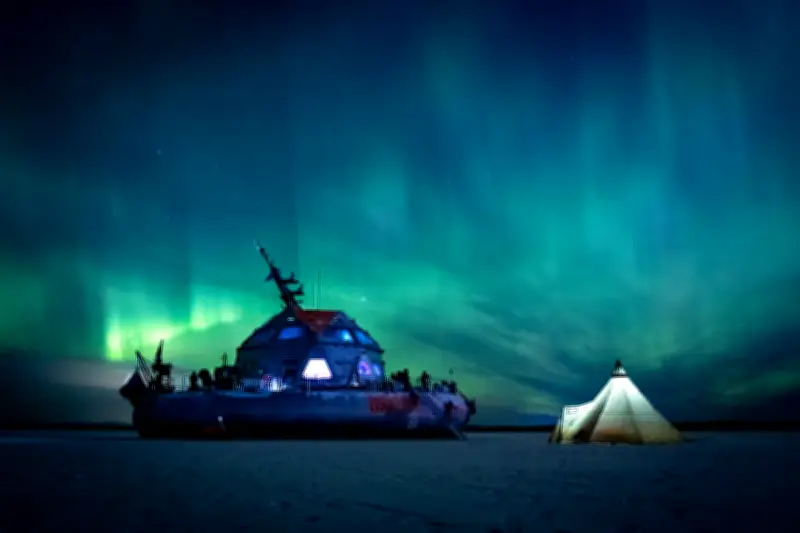
Six scientists and six crew members will travel next month to Kirkenes, a remote Arctic town in Norway near the Russian border, to begin an eight-month odyssey aboard the Tara polar station, a futuristic floating laboratory built to be frozen into pack ice. The team will endure months of complete darkness and temperatures as low as -50C (-58F) as they drift slowly over the North Pole to Greenland.
Mission to document unknown ecosystems
Their mission is to gather data on the impact of climate breakdown and pollution on the central Arctic Ocean’s unique and largely unknown ecosystems before they change forever. “We are losing species before we have time to discover them,” said Romain Troublé, a microbiologist turned sailor and executive director of the Tara Ocean Foundation. “In the next 20 years, everything will shift.”
Troublé was awarded the prestigious Shackleton medal this week for his work on developing the polar station. In 2023, Nature magazine described him and Étienne Bourgois, co-founder of the Tara Ocean Foundation, as “visionary thinkers,” comparing their expedition to Charles Darwin’s voyage on HMS Beagle.
Design and funding
The design of the station came from Agnès Troublé and Bourgois, while Romain Troublé raised the required €26m (£22m) funding and organized the mission. The vessel measures 26 metres long and 16 metres wide, and is built to withstand being frozen into the ice. The expedition is the first stage of a planned continuous 10-leg journey spanning 20 years, aimed at driving policy changes to protect the Arctic.
“We know pretty well the depth, the physics of the Arctic. But we have no clue about the life, the biological aspect. It is a blank sheet to discover,” Troublé said. The scientists and crew will be highly remote; while rescue is possible in an emergency, it could take a week to reach them.
Race against time
The Arctic is warming three to four times faster than anywhere else on the planet, and sea ice that once protected the region is melting fast, exposing the sea to threats from shipping, fishing, mining, and pollution. Dr. Nina Schuback, a biological oceanographer from the Swiss Polar Institute, will join the expedition. “We know that the central Arctic Ocean is changing really, really rapidly. If you want to talk about the effect this has on biology, it is very hard to get data,” she said.
The Arctic Ocean supports an interconnected web of life, from polar bears and walruses to microbes like ice algae. Schuback and her colleagues will sample microbes in seawater through the station’s “moon pool,” a central opening that also serves as a launch point for divers, underwater drones, and remotely operated vessels. They hope to discover new species adapted to the region where the sun does not rise for almost half the year.
Human challenges
Schuback, who underwent a rigorous selection process likened to evaluation for the International Space Station, admitted she is both “excited and scared” at the prospect of a polar winter. “I’ve never experienced polar night. My biggest fear is the darkness. You get tired,” she said, adding that time will pass quickly with exciting science. “How often do you get the chance to do something like this? I feel very privileged.”



