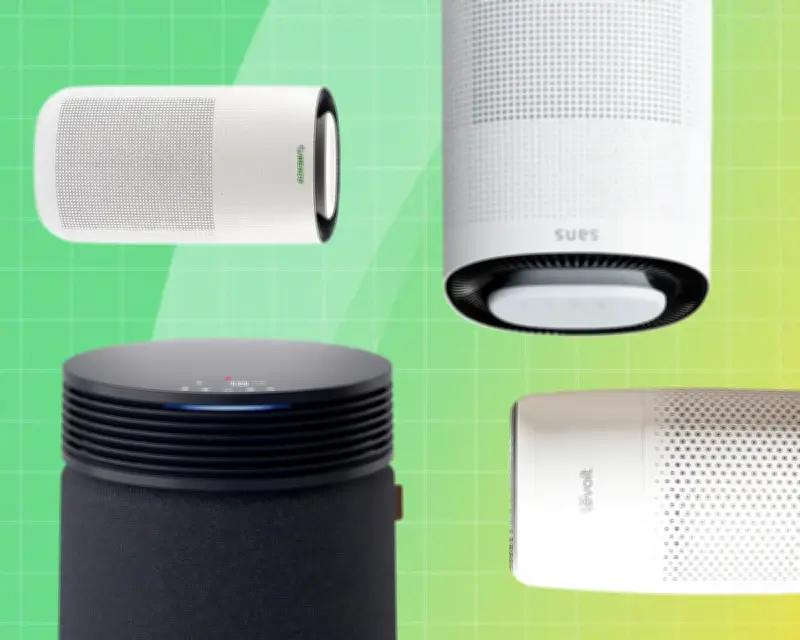
Whether you suffer from hay fever, have damp rooms, or simply want to breathe cleaner air, an air purifier can make a significant difference. Air pollution, including industrial emissions, exhaust fumes, and dust, remains one of the most serious environmental health risks in the UK, particularly affecting densely populated and low-income areas. While outdoor air quality is beyond individual control, a good air purifier can sanitise indoor air, capturing harmful particles such as dust, pollen, pet dander, and volatile organic compounds (VOCs).
Air purifiers vary widely in effectiveness, filtration, range, and additional features. After testing 10 popular models, we selected the seven best for this guide.
At a glance
- Best air purifier overall: Blueair Blue Signature Large – £369 at Amazon
- Best budget air purifier: Levoit Core Mini LAP-C161-WUK – £39.99 at Levoit
- Best mid-size air purifier: MeacoClean CA-Hepa 76x5 – £200 at Peter Tyson
- Best small air purifier: Sans air purifier Mini – £199.99 at Healf
Why you can trust me
I have tested countless products for publications including the Filter over the past decade. Air purifiers require rigorous testing with repeatable conditions and careful measurement. My reviews focus on how well each purifier cleans the air, not just its appearance. I take health-focused products especially seriously, grounding my approach in extensive reading on air quality and its effects. Some brands did not want their purifiers returned after testing; these units have been donated to the Cat Action Trust 1977, a charity for feral cats.
How I tested
I measured how effectively each purifier sanitised the air in my home. For each model, I degraded air quality by cooking, doing DIY, or lighting a wood fire until my air quality monitor indicated a PM2.5 particulate count above 5µg/m³. I then ran each purifier at its highest fan setting for one hour, recording the reduction in PM2.5 count. I also measured electricity use with a power meter and noise levels with a sound meter. Additionally, I assessed performance on low or auto settings and considered design, ease of use, and extra functionalities like dehumidification and cooling.
Best air purifier overall: Blueair Blue Signature Large
Price: From £369 at Argos and Amazon
What we love: Superior purification and attractive design
What we don’t love: Too large and expensive for many homes
Designed to capture 99.97% of airborne particles in a large home, this super-sized, Scandi-chic purifier leaves no molecule unaddressed. It was the most powerful model tested, slashing PM2.5 to 0.5µg/m³ within 15 minutes on the highest setting. The unit can double as a table, and its digital display integrates mode selection and air quality readouts. Lower fan settings are tranquil, and auto mode adjusts speed automatically. Remote operation via app is available. However, high fan speeds create a cooling effect, which may be less desirable in winter.
- Filtration: Seven-stage HepaSilent filter (mechanical and electrostatic) capturing particles as small as 0.1 microns
- Recommended for spaces up to: 65m² floor area
- Air quality improvement in one hour (PM2.5): 22 to 0.4µg/m³
- Percentage improvement: 98%
- Power use in one hour: 0.038kWh
- Maximum operating noise: 62dB
- Size: 40 x 40 x 44cm (WDH)
Best budget air purifier: Levoit Core Mini LAP-C161-WUK
Price: From £39.99 at Levoit and Amazon
What we love: Superb energy efficiency; good purification in small spaces
What we don’t love: Insufficient power for large rooms
This miniature, bedside-friendly purifier has three manual fan speeds and an integrated scent pad compartment for essential oils. It trapped about half of airborne PM2.5 in my kitchen within an hour, using minimal electricity. Exceptionally small and lightweight, it is easy to move around and quiet on the lowest setting. However, it is only powerful enough for close-quarters purification in small rooms.
- Filtration: CoreMini-RF three-layer Hepa filter
- Recommended for spaces up to: 34m² floor area
- Air quality improvement in one hour (PM2.5): 9.8 to 4.2µg/m³
- Percentage improvement: 57%
- Power use in one hour: 0.006kWh
- Maximum operating noise: 52dB
- Size: 16.5 x 16.5 x 26.4cm (WDH)
Best mid-size air purifier: MeacoClean CA-Hepa 76x5
Price: £200 at Peter Tyson
What we love: The best purification at a mid-market price
What we don’t love: PM2.5 readouts are not always reliable
This powerful model for spaces up to 126m³ dropped PM2.5 by 80% within 10 minutes on high setting. The lower fan speed is usually adequate and quiet. An integrated handle and on-unit controls allow mode switching, timed purification, and optional ionisation. It can be controlled via the SmartLife app. However, the particulate sensor sometimes displayed zero when my monitor indicated otherwise.
- Filtration: H13 Hepa filter
- Recommended for spaces up to: 126m³ room volume
- Air quality improvement in one hour (PM2.5): 10.8 to 1.2µg/m³
- Percentage improvement: 89%
- Power use in one hour: 0.044kWh
- Maximum operating noise: 69dB
- Size: 30.3 x 27 x 49.7cm (WDH)
Best small air purifier: Sans air purifier Mini
Price: £199.99 at Healf
What we love: Excellent, compact design; decent purification performance
What we don’t love: Setup was relatively fiddly; won’t suit large spaces
This purifier makes great use of space with a filter compartment containing a Hepa filter and almost half a kilogram of activated carbon. On the highest setting, it reduced PM2.5 by 50% in eight minutes after burnt toast. Adaptive coloured lighting and a UV-C light indicate air purity and kill germs. The digital display shows PM2.5, PM10, and VOC levels. Auto mode adjusts fan speed based on air quality. However, removing the filter from packaging was fiddly.
- Filtration: Hepa filter (0.3 microns), activated carbon, UV-C light
- Recommended for spaces up to: 46m² floor area
- Air quality improvement in one hour (PM2.5): 10.2 to 4µg/m³
- Percentage improvement: 61%
- Power use in one hour: 0.025kWh
- Maximum operating noise: 61dB
- Size: 20 x 23 x 36cm (WDH)
The best of the rest
SwitchBot air purifier table
Price: From £169.99 at SwitchBot and Amazon
Best for: Tech extras
This purifier features a scent tray, timed purification, colour-changing LED, and Alexa compatibility. The oval tabletop can wirelessly charge a smartphone. However, relative to the price, performance is good but not excellent.
- Filtration: Hepa and activated carbon
- Recommended for spaces up to: 33m² floor area
- Air quality improvement in one hour (PM2.5): 10.1 to 4.3µg/m³
- Percentage improvement: 57%
- Power use in one hour: 0.045kWh
- Maximum operating noise: 62dB
- Size: 29 x 42 x 49.8cm (WDH)
MeacoDry Arete One 6l dehumidifier and air purifier
Price: From £129.99 at Meaco and Amazon
Best for: A dehumidifier and air purifier in one
Ideal for homes affected by damp and mould, this model combines dehumidification with gentle purification through an H13 Hepa filter. It pushed my monitor readings into the green within seven minutes. However, purification control is basic, and it is heavy.
- Filtration: Hepa or activated carbon
- Recommended for spaces up to: 25m² floor area
- Air quality improvement in one hour (PM2.5): 10.9 to 3.7µg/m³
- Percentage improvement: 66%
- Power use in one hour: 0.006kWh
- Maximum operating noise: 48dB
- Size: 31.9 x 23.7 x 47.2cm (WDH)
Blueair Mini Restful sunrise clock air purifier
Price: From £169 at John Lewis and Blueair
Best for: Use in the bedroom
This unique purifier features dawn simulation to brighten mornings. Purification performance is impressive for a mid-size room, with multiple fan speeds. However, its full functionality as a sunrise alarm clock is only relevant for bedrooms.
- Filtration: HepaSilent filter with mechanical and electrostatic filtration
- Recommended for spaces up to: 31m² floor area
- Air quality improvement in one hour (PM2.5): 12.1 to 3.7µg/m³
- Percentage improvement: 69%
- Power use in one hour: 0.038kWh
- Maximum operating noise: 50dB
- Size: 17 x 17 x 28.3cm (WDH)
What you need to know
What do air purifiers remove from the air?
Air purifiers remove small particles (particulates) such as dust, pollen, pet dander, and fumes. The specific particles captured depend on the filter. Hepa filters capture microscopic particles including dust, pollen, mould spores, and bacteria. Activated carbon filters trap volatile organic compounds (VOCs) like cooking or paint fumes. For thorough purification, a purifier with both Hepa and activated carbon filters is recommended. Filters must be replaced when saturated.
How often should air purifier filters be replaced?
Brands often recommend replacing filters every six months to a year, but effectiveness decreases mainly through particulate accumulation. To avoid unnecessary replacements, use an air quality monitor to confirm your purifier is still improving air quality.
What is the ideal air quality for a home?
The WHO advises annual average PM2.5 levels below 5µg/m³. Routine activities like cooking or lighting a stove can spike particulate counts. An air purifier helps ensure the long-term average stays under 5µg/m³. Other helpful measures include limiting polluting activities, opening windows when outdoor air is good, and vacuuming regularly.