Royal Opera's Rigoletto Revival: A Violent, Revelatory Take on Verdi's Classic
The Royal Opera House in London has revived Oliver Mears's 2021 production of Giuseppe Verdi's Rigoletto, presenting a staging that powerfully evokes a world of privilege, misogyny, and abuse. This strong revival, running until 23 April, features compelling performances and revelatory musical direction under conductor Mark Elder, making it a standout in the current opera season.
A Staging Rooted in Historical and Artistic References
Mears's production opens with a clear nod to the original target of Verdi's opera: Vincenzo I, one of the most reprehensible Gonzaga Dukes of Mantua. Known as a womanizer and murderer, Vincenzo was also a generous patron of the arts, employing Rubens and commissioning Monteverdi's L'Orfeo. The curtain rises on a still-life tableau, with Fabiana Piccioli's chiaroscuro lighting visibly inspired by Caravaggio, revealing the Duke posing as an armour-clad minotaur, sword poised for the kill.
Simon Lima Holdsworth's stonework set suggests Renaissance Mantua, but it quickly becomes apparent that this is a court where dress-up dominates. The Duke's followers wear flamboyant loungewear, modern in feel but designed by Ilona Karas to echo their master's artistic tastes. They are a rotten lot, regaling him with fawning dances choreographed by Anna Morrissey. In the wake of the Epstein files, the production all too readily evokes a gilded world of privilege, entrenched misogyny, and complicit abuse.
Performances That Bring Depth and Nuance
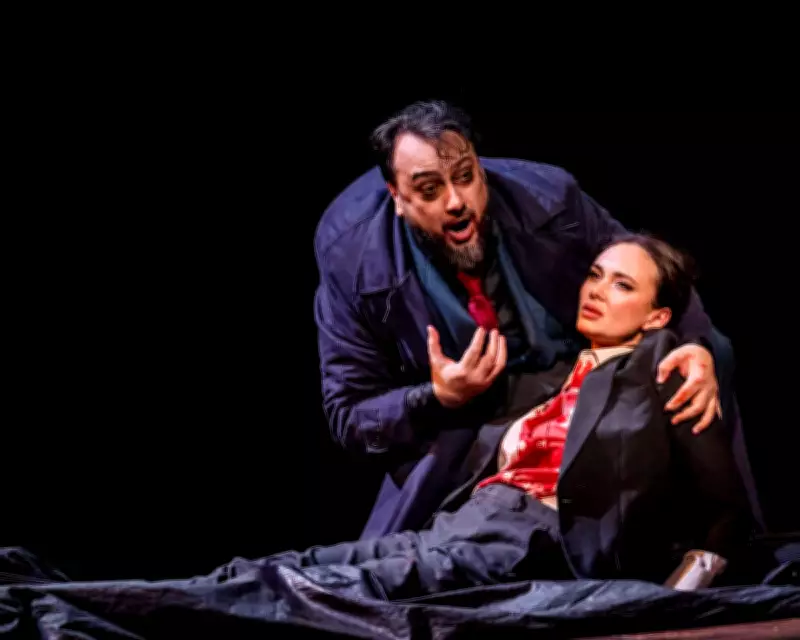
George Petean's Rigoletto is a beetling, shot-nerved bundle of guilt, with a touch of Tony Soprano about him. His sensitive interpretation of Cortigiani, Vil Razza Dannata highlights the jester's bitter humiliation, with a steely baritone that commands attention. Aida Garifullina portrays Gilda with convincing elegance, moving from girlish naivety to a conflicted victim of trafficking. Her creamy soprano and elegant phrasing transform Caro Nome into far more than a mere coloratura showcase.
Iván Ayón Rivas delivers an impetuous, shamelessly preening Duke, his bright tenor bursting with Italianate charm, though La Donna è Mobile is unfortunately set in an awkward corner of the stage. William Thomas sings Sparafucile with a dark beauty and supple heft, blending ruthless killer with self-satisfied artisan. Anne Marie Stanley's booze-soaked Maddalena cuts a sympathetic figure, forced to ply her trade in a rancid bedroom.
Thematic Emphasis and Musical Excellence
Physical violence is emphasized throughout the production, with the Duke's blinding of Monterone on a whim proving as shocking as parallel scenes in King Lear. Sexual violence remains mostly implicit, though complex scenes are clarified through careful blocking. There is an occasional over-reliance on operatic gestures and romantic clinches that can undermine expressive truth, but the tumultuous Act III rainstorm provides a marvellous splash of theatrical realism.
Steering the production is Mark Elder, an immensely experienced Verdi conductor whose measured pacing and attention to instrumental detail are frequently revelatory. His thoughtful approach guarantees emotional weight and lyrical flexibility, never failing to deliver dramatic impact. This revival not only showcases strong performances but also reinforces the timeless relevance of Verdi's work, making it a must-see for opera enthusiasts and newcomers alike.