Crown of Blood Review: Macbeth's Deadly Hurly-Burly Rooted in Mythic Yoruba Landscape
At Sheffield's Crucible theatre, a powerful new production takes Shakespeare's timeless tragedy and transplants it into a rich, mythic Yoruba landscape. Oladipo Agboluaje's Crown of Blood reimagines Macbeth's deadly power play within 19th-century West Africa, creating a compelling theatrical experience that feels both ancient and urgently contemporary.
A Supernatural World of Prophecy and Ambition
From the moment court historian Arokin, played by Toyin Oshinaike, arrives with his extraordinary reports of flying elephants and gorillas with tortoise shells, the audience is transported to a world where the supernatural is not merely a plot device but an all-encompassing reality. This production, presented by Utopia and Sheffield Theatres under Mojisola Kareem's direction, establishes its mystical credentials from the outset.
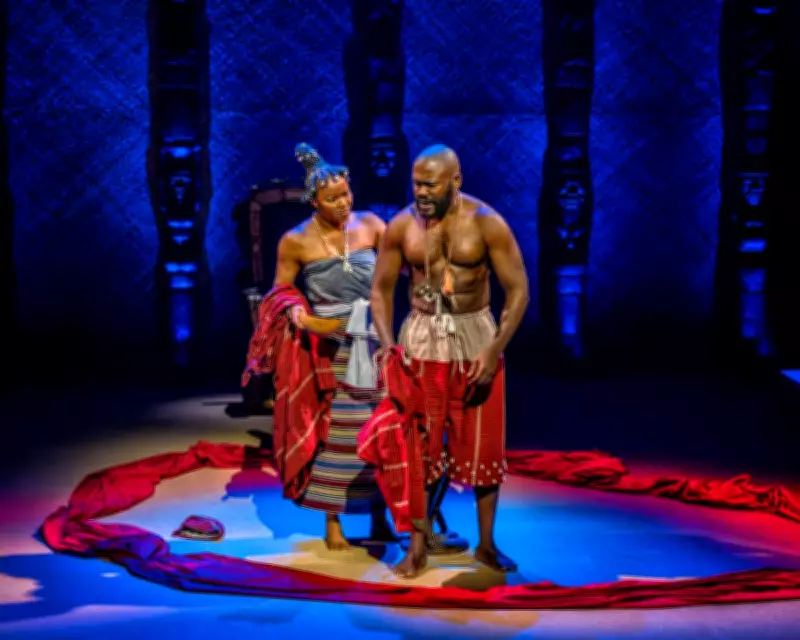
The central couple, Aderemi and Oyebisi, portrayed with compelling chemistry by Deyemi Okanlawon and Kehinde Bankole, find their lives transformed by prophetic dreams. When Oyebisi reveals her vision of a crown placed upon her husband's head, she sets in motion a chain of events that will transform the modest warrior into a ruthless despot. "I am doing the bidding of the gods," declares Aderemi with chilling conviction, highlighting how completely this production embraces its spiritual framework.
Mythic Yoruba Landscape and Eternal Struggle
Mojisola Kareem's production creates a vivid theatrical world where deity Esu, played by Patrice Naiambana in pointy cap and red rags, feels as tangible as the amulets and shells that cast spells over the characters. This setting in a mythic Yoruba landscape serves to frame the human drama as part of an eternal struggle, with the inhabitants appearing as temporary players in a much larger cosmic narrative.
The central performances anchor this ambitious production. Okanlawon's Aderemi begins as a likable, modest soldier whose transformation into tyranny feels both shocking and inevitable. Bankole's Oyebisi brings equal measures of devotion and determination to her role, with the production notably allowing her character to remain present and coherent throughout the drama, avoiding the traditional descent into madness that often befalls Shakespeare's Lady Macbeth.
Shifting Focus from Psychology to Politics
Where Agboluaje's adaptation particularly diverges from its Shakespearean source is in its shifting of focus from psychological insight to political commentary. While this approach provides less internal reflection for Aderemi's character, it allows the play to explore broader themes of power, governance, and social impact.
The playwright redirects attention toward the politics of succession, with royal houses negotiating their positions while attempting to contain a headstrong leader. This political dimension becomes increasingly prominent as the drama unfolds, culminating in powerful visual symbolism as the throne dangles midair, suspended by streams of blood on Kevin Jenkins's striking set design.
A Warning for Contemporary Times
The production's contemporary relevance becomes particularly apparent in its closing moments, when a survivor of the carnage declares, "It must never happen again." This warning resonates powerfully beyond the theatrical space, serving as a stark reminder about the dangers of demagoguery and unchecked ambition in any era.
Crown of Blood represents a significant achievement in cross-cultural theatrical adaptation, successfully transplanting Shakespeare's exploration of power into a distinctly Yoruba context while maintaining the essential tension and drama of the original. The production continues at Sheffield's Crucible theatre until 7 February before embarking on a national tour, offering audiences across the country an opportunity to experience this innovative reimagining of a classic tragedy.