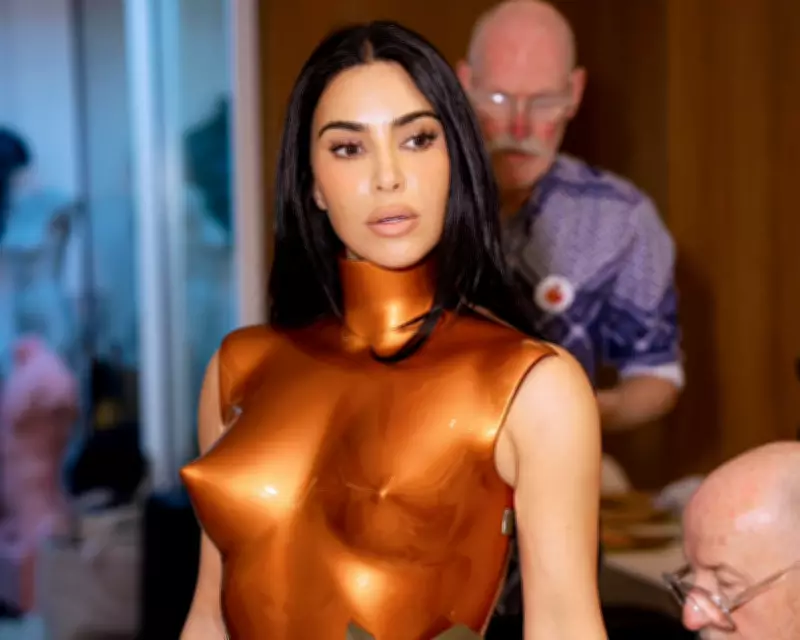
At Monday's Met Gala, Kim Kardashian delivered the evening's biggest jolt by wearing an orange fibreglass breastplate created by east London art duo Whitaker Malem and a car bodyshop in Kent. The breastplate, which interpreted the 'fashion is art' dress code, replaced her usual role as a walking billboard for major fashion houses.
Collaboration and Creation
Patrick Whitaker, 61, of Whitaker Malem, said Kardashian was clear about wanting a breastplate with a car body finish. The piece was a three-way collaboration with British pop artist Allen Jones and visual artist Nadia Lee Cohen. Kardashian attended the gala with Jones, whose fetishistic furniture has influenced fashion for decades.
The breastplate was cast from an original mould derived from Jones's 1969 Hatstand sculpture. Whitaker Malem added a hand-painted leather skirt. Kardashian flew to the UK and visited Jones's Oxfordshire home for fittings, with her body dummy in tow.

Production Process
The breastplate was made from glass-reinforced plastic and weighed as much as a bag of flour. It was sprayed orange by Martyn Smith at MPS Body and Paint in Lydd, Kent, using several layers of primer, solvent base paint, and gloss lacquer. Smith, who usually works on cars, was nervous but pleased with the result.
Whitaker and Malem, who founded their practice in 1988, describe themselves as 'pop artisans'. They make about 12 garments a year, primarily working with leather using wet-moulding techniques. The breastplate was collected days before the gala by a courier who flew first class from Los Angeles and stored it in an overhead locker.
Background of Whitaker Malem
The duo met when Whitaker was a student at St Martin's and Malem worked in theatre. They have dressed celebrities from Cher to Bella Hadid and worked with designers like Tommy Hilfiger and Burberry. Their film work includes Brad Pitt's skirt in Troy, Wonder Woman's suit, and several Bond girl costumes. They also created Christian Bale's batsuit, which led to their use of 3D scanning and printing.
Jones's work has faced criticism, but Malem noted that with Kardashian, he flipped the narrative: 'Instead of the usual girl draped across the car, he wanted to put the car on the girl.'