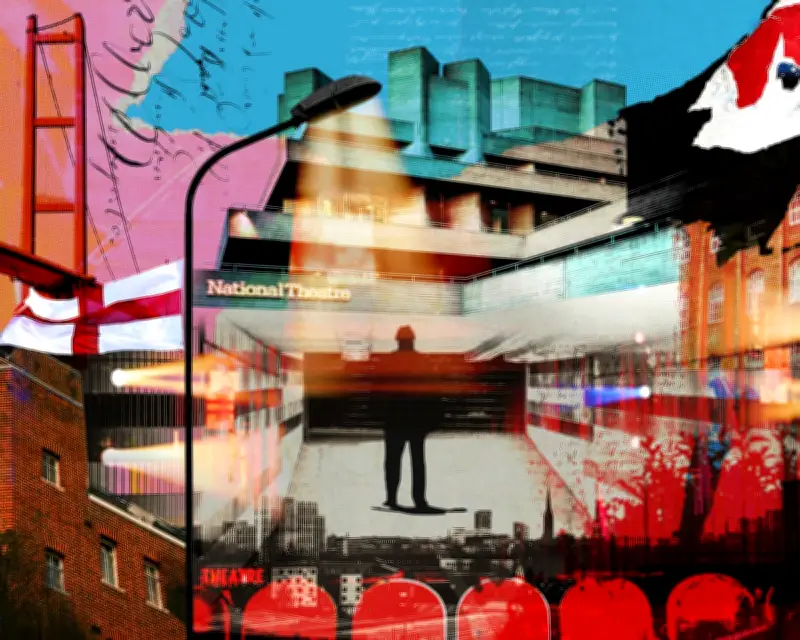
Playwright James Graham has defended the importance of publicly funded arts in telling Britain's stories, drawing on his own career and the 80-year history of Arts Council England. In a personal reflection, Graham highlights how theatre and culture serve as a lens for communities to see themselves and navigate national narratives.
The power of the St George's Cross on stage
Graham recalls the opening night of his play Dear England at the Nottingham Theatre Royal in September 2025, the first production funded through Arts Council England's incentivising touring scheme. The play features a large St George's Cross unfurled on stage, a symbol that had become increasingly controversial after a campaign to hang the flag on lamp-posts across England in summer 2024. Graham notes the 'intake-of-breath moment' in the theatre, illustrating how live performance can handle nuance and empathy in a polarised world.
Theatre as a story factory
Graham describes theatres as 'story factories' that offer communities a way to see their lives reflected. He credits his own development as an artist from an unlikely background to the publicly funded cultural sector, recalling his first professional Shakespeare production at age 16 and later working as a stage door keeper at the same theatre.
Keynesian roots of arts funding
The playwright traces the origins of state investment in culture to economist John Maynard Keynes, who drove the foundation of the Arts Council in 1946. Graham notes that Keynes saw no contradiction between fiscal discipline and funding for the arts, a principle that continues to guide policy.
Hull City of Culture: a case study
Graham highlights Hull's tenure as UK City of Culture in 2017, supported by Arts Council England, as an example of storytelling empowering a place. An evaluation found that three out of four residents felt increased pride in place, and self-esteem rose markedly among young people. Work produced that year covered topics from the collapse of the fishing industry to Hull's role in the slave trade.
Reversing cultural inequality in the East Midlands
Graham points to his own community in Nottinghamshire, where a decade ago Ashfield was ranked 647th out of 650 constituencies for access to art and culture. In July 2024, Arts Council England invested £1 million in Ashfield Creates, a three-year programme to transform access to the arts. He describes this as a 'Keynesian intervention' that is reversing a long-standing trend of underinvestment in the East Midlands.
Stories as instruments of understanding
While acknowledging that stories alone cannot fix all social ills, Graham argues they are 'disproportionately effective instruments' for helping people know themselves and see themselves as part of a bigger picture. He concludes by reflecting on writing the BBC montage for the England final at Euro 2024: 'A country is only the stories we tell ourselves, about ourselves.'