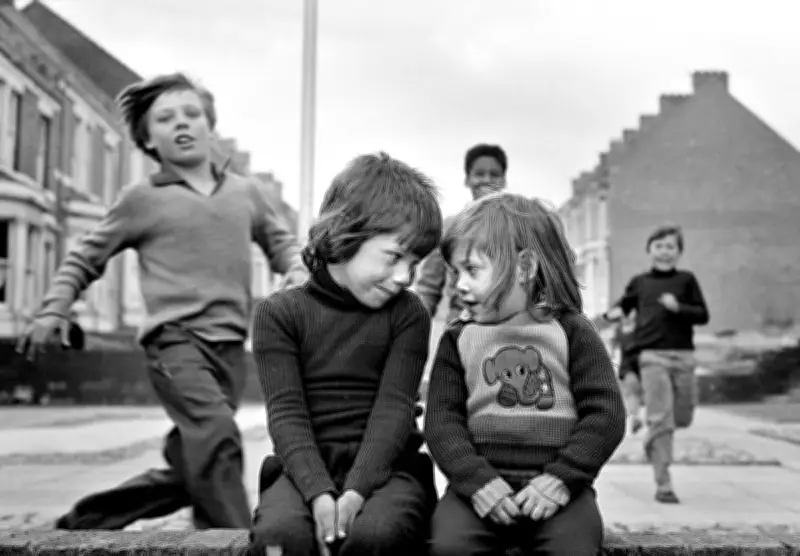
The exhibition Close to Home at Baltic, Gateshead, brings together the work of photographers Tish Murtha and Kuba Ryniewicz, but their contrasting visions of north-east England struggle to form a cohesive narrative. While both artists capture the human pursuit of happiness, the gulf in context and approach undermines the pairing.
Murtha's Unflinching Gaze on 1980s Newcastle
Tish Murtha’s photographs, shot between 1979 and 1981 in Newcastle, document the impact of deindustrialisation. Her series Youth Unemployment shows young men slouching, smoking, and sharing jokes amid economic decline. In Elswick Kids, children play on cobbled streets, swing from burned-out cars, and stand beside a window marked “Muggers corner.” Murtha’s work is raw, honest, and vibrant, focusing on human resilience under extreme pressure. She died in 2013, and Close to Home features four of her major collections—Elswick Kids, Save Scotswood Works, Youth Unemployment, and Elswick Revisited—exhibited together in the north-east for the first time.
Ryniewicz's Playful Present-Day Images
Kuba Ryniewicz, born in Poland and based in Newcastle since 2004, presents works from series Daily Weeding, Cornered Study, and Good Eggs, all shot within the last six years. His photographs are vivid, colourful, and cheeky, depicting weeds, buses, baby bumps, and suburban shadows. A cow stands bemused beneath an office block; a sunbathing man with a tattoo reading “stars can’t shine without darkness” glistens on mottled grass. Ryniewicz’s film asks present-day Newcastle residents what made them happy today—answers include sun, breakfast, and connecting with loved ones—echoing the universal joys Murtha’s subjects might have shared.
Exhibition Layout Highlights Disconnect
Murtha’s photographs are hung salon-style in varied sizes, with one enlarged image per series covering nearly an entire wall. Campaign materials accompany Save Scotswood Works, and clips from Paul Sng’s documentary Tish play alongside her work. Ryniewicz’s images, mostly unframed and glued directly to the wall, dance around the room between Murtha’s collections. Despite equal billing, Murtha’s historical weight dominates, forcing Ryniewicz’s playful works to compete for attention.
Collision of Contexts Undermines Cohesion
The exhibition’s central problem is the irreconcilable difference in subject matter and tone. A protest against the closure of Scotswood Works sits opposite a guinea pig snuggling into a man’s chest. Murtha’s brother clearing beer bottles at the kitchen sink contrasts with a full-colour image of a pregnant belly bumping into a vase of flowers. As one critic notes, “You can’t pair the mother pressing her temples, or the boy staring out of an abandoned house with someone discussing the joy of painting or hugging trees.”
Unequal Billing and Lack of Dialogue
Wall texts further widen the gap: Murtha’s work is described in factual, historical terms, while Ryniewicz’s is framed conceptually. Murtha shoots off-the-cuff; Ryniewicz often stages his images. The result is an exhibition where one artist’s practice bends around the other’s. “It is a worthwhile endeavour, searching for a contemporary conversation for Murtha’s work,” the review concludes, “but Close to Home feels quite far off the mark.” Both photographers are outstanding individually, but their pairing here fails to create a meaningful dialogue.