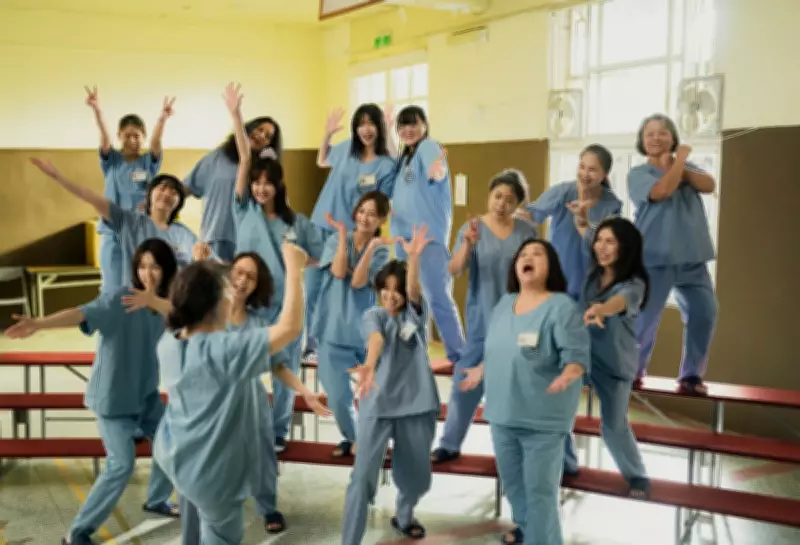
Sunshine Women's Choir Review: A Taiwanese Box Office Phenomenon Drowned in Excessive Sentiment
Sunshine Women's Choir, the record-breaking Taiwanese prison musical that has become the nation's biggest local box office hit, is facing severe critical backlash for what reviewers describe as increasingly manipulative and emotionally exploitative tactics. This schmaltzy film about a choir of female inmates might induce tears, but according to critics, those tears stem more from exasperation, frustration, and sheer disbelief rather than genuine heartfelt emotion.
A Cinematic Offense Worthy of Probation
Reviewers have suggested that everyone involved with this peculiar feelgood-slash-feelbad prison weepie should be placed on immediate cinematic probation. The recommendation is that they be banned from filmmaking until it is definitively clear they no longer pose a danger to public cinematic sensibilities. The film begins as a heavy dose of schmaltz but rapidly escalates its tactics, relentlessly attempting to extract every possible drop of emotion from its audience. The approach has been compared to a merciless prison warden during a tightly controlled exercise hour.
The final stages of the movie feature such an overwhelming amount of theatrical crying that critics humorously note the inmates could have potentially floated over the prison walls on the rising tide of their own collective tears.

Plot and Adaptation from Korean Origins
The story is adapted from the 2010 Korean film Harmony. It centers on Hui-Zhen, portrayed by Ivy Chen, a woman who must raise her infant daughter, Yun-shi, from behind bars after being imprisoned for murdering her abusive husband. The film presents a curiously plush depiction of incarceration, with Hui-Zhen's cell featuring soft-play fittings and remarkably supportive cellmates. Among them is former stage diva Yu-ying, played by veteran singer Judy Ongg, known for her role in Peter Greenaway's The Pillow Book.
Hui-Zhen faces immense pressure from the stern warden, Chief Fang, played by Miao Ke-li, who urges her to give up Yun-shi for adoption. The situation becomes critically urgent when the young child develops a vision-threatening cataract that Hui-Zhen cannot afford to treat. In a desperate bid to provide her music-loving toddler with a happy farewell, Hui-Zhen coerces her fellow inmates into forming the titular Sunshine Women's Choir.
Directorial Approach and Missed Opportunities
Director Gavin Lin ostensibly models the film on the classic showbiz-underdog template popularized by movies like The Full Monty. He also incorporates several Pitch Perfect-style musical showstoppers. However, critics argue that the film's relentlessly peppy and upbeat tone fundamentally undermines any potential for foundational grit or authentic drama.
For instance, the hazing received by a teenage new arrival, You-xin, played by Ho Man-xi, is laughably sanitized, though the character is revealed to be a talented dancer. Instead of meaningfully integrating the inmates' complex personalities and troubled pasts into the choir's narrative arc, Director Lin opts for melodramatic solo flashbacks that feel disconnected and pointless.
When the film lacks actual dramatic tension, Lin's default solution appears to be inserting yet another cutaway to the adorable Yun-shi clapping along to the musical schlock, a tactic criticized as a cheap emotional ploy.
An Unrelenting Assault on the Hankies
Rather than building towards a satisfying musical or narrative crescendo for the choir, the director chooses to relentlessly crank up the sentimentality to extreme levels. The plot reveals that Yu-ying is battling cancer, leading to a scene where the inmates, from the prison courtyard, console her grieving daughter outside the perimeter wall through the power of song.
This emotional manipulation pales in comparison to a later, staggeringly contrived reunion scene set a few years in the future. It features Hui-Zhen and a now-older Yun-shi in a scenario that, in reality, would raise serious alarm bells regarding Taiwanese prison authorities, adoption protocols, and the judicial system's duty of care. Critics note that this disregard for plausibility is emblematic of the film's overall approach.

Sunshine Women's Choir is scheduled for release in UK cinemas starting April 17th, allowing international audiences to judge this polarizing Taiwanese phenomenon for themselves.