The 2026 Venice Biennale, the world's largest art exhibition, has been plagued by controversy from the start. Countries withdrew, artists were fired, and the jury resigned before the opening. Protests against Israel and Russia, strikes, and artworks replaced with Palestinian flags marked the preview. Curator Koyo Kouoh, who died last year, envisioned a theme of spiritual and physical rest titled In Minor Keys, focusing on quiet contemplation and healing. However, in a world ravaged by wars, climate crisis, and political upheaval, this theme feels wildly inappropriate.
The Main Exhibition: A Disjointed Mess
The central shows in the Giardini and Arsenale, curated by a five-person team, lack coherence. The exhibition is a vast, poorly explained collection of art from the global south, but without context or connection. Visitors wander through rooms filled with ceramics, textiles, and paintings, struggling to find meaning. The theme of rest results in anodyne works: slide projectors, rocks, serene forest videos. Politics and conflict are conspicuously absent.
Despite the overall confusion, some individual works stand out. Seyni Awa Camara's animal-human hybrid pots are stunning, towering terracotta figures. Celia Vásquez Yui's glazed creatures transform a gallery into a jungle. Mohammed Z Rahman's matchbox paintings depict queer heartbreak, while Tammy Nguyen's canvases link the cold war to Vietnam. Wardha Shabbir's maximalist miniature paintings are gorgeous. The Nairobi Contemporary Art Institute room features eerie, aggressive works by Josephine Alacu, C Driciru, and Charles Mukiibi.

The Arsenale space works better, with bigger, weirder pieces. Guadalupe Maravilla's trashy thrones address cancer and immigration; Theo Eshetu's spinning olive tree meditates on death; Kaloki Nyamai's handmade canvases show trauma; Dawn DeDeaux's meteorites and glass confront Hurricane Katrina. Alfredo Jaar's blinding red corridor leads to a cube of rare-earth minerals, a critique of exploitative greed. However, the lack of material diversity—terracotta, dye, textiles, beads—makes the exhibition blur together.
National Pavilions: Ludicrous and Fun
The national pavilions offer relief from the main show's tedium. Denmark's pavilion is a hi-tech sperm bank; Luxembourg's features a singing turd; Japan's forces visitors to care for fake babies. Malta presents a life-size chocolate Russell Crowe. Belgium's pavilion resembles a hyper-serious art school version of the Blue Man Group, with performers screaming and hitting drums.
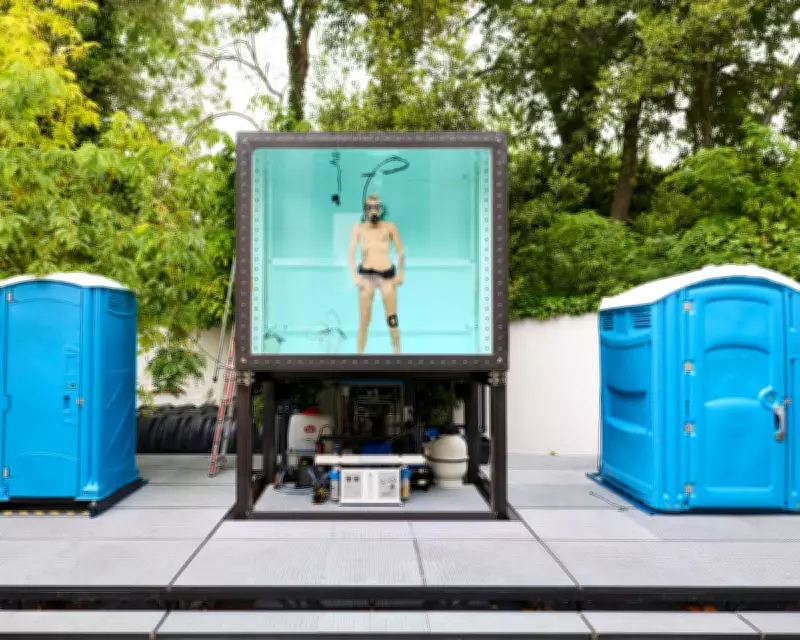
Andreas Angelidakis transforms the Greek pavilion into a nightclub/kink dungeon with deflated phallic columns, critiquing the commodification of Greek culture. Florentina Holzinger's Austrian pavilion is the most talked-about: a confrontational performance involving a woman submerged in a tank connected to portaloos, where visitors' urine is filtered and fed back into the tank. Next door, a sewage system sprays raw effluent against windows. The work is obscene and vile, a diatribe on climate change and hidden support systems.
Slovenia's pavilion, by Nonument Group, commemorates a mosque built among military barracks in 1917. It is a wasteland of cinder blocks and rubble, a moving monument to loss and militarization. The Vatican's off-site pavilion offers sonic calm: musicians like Devonte Hynes and Brian Eno created music inspired by Hildegard of Bingen, played through headphones in a lavender garden. For 30 minutes, one can forget war and find peace.
Unofficial Exhibitions: True Artistic Bravery
The contested pavilions—Israel's water feature, Russia's florist-like display, America's boring hotel lobby art—proved anticlimactic. The real power lies in unofficial exhibitions. Belarus Free Theatre's presentation exposes totalitarianism with a wheat field and a crucifix of CCTV cameras. Gabrielle Goliath, cancelled by South Africa's culture minister, installed a video in a church: singers sustain notes until their lungs give out, a lament for women lost to violence. The church hums with heartbroken voices.

At Fondazione Prada, Richard Prince and Arthur Jafa's show explores American appropriation, racial hatred, and sexual exploitation. Lorna Simpson's retrospective at Pinault Collection features images of race riots and bullet holes. Lawrence Abu Hamdan's film at Fondazione Inbetween Art Film examines sonic weapons used against students in Belgrade. Maya Watanabe's film of a mammoth carcass emerging from permafrost portrays ecological disaster.
Tech, absent from the main show, appears elsewhere. Eva and Franco Mattes tackle AI and cat memes at Palazzo Franchetti. Holly Herndon and Mat Dryhurst's group show at Palazzo Diedo explores protocol art with AI networks. Lydia Ourahmane's show at Nicoletta Fiorucci Foundation uses materials of Venice—simmering stock, bead curtains—to decontextualize the city. It is ultra-minimalist but moving.
Conclusion
The Venice Biennale is overwhelming, with thousands of artworks across the city. This review only scratches the surface, missing Georg Baselitz's final works, Jenny Saville, and Sanya Kantarovsky. Amid the chaos, visitors must seek personal connections. Whether in the alleys or palazzos, the biennale offers moments of brilliance, but its main exhibition fails to address the crises of our time.