In a poignant personal narrative, Anita Bhagwandas recounts a transformative moment from her childhood in south Wales that shaped her entire perspective on beauty and identity. At just 12 years old, she applied her first-ever makeup: a tube of green mascara purchased from a local pound shop. This was not a fashionable shade but a frosted, mucous-tinted green that resembled the aftermath of a minor chemical mishap involving Shrek, as she vividly describes. Despite its unappealing appearance to others, she felt an instant connection to how it altered her face, marking the beginning of a lifelong journey of self-discovery.
The Polarizing Power of Early Experimentation
Bhagwandas details how the outside world reacted with disdain to her green mascara. Teachers demanded she remove it, only for her to reapply it secretly in school toilets. Peers looked on with genuine repulsion, unable to comprehend why she would choose such an unconventional look. Yet, she loved the transformation and the discomfort it provoked, realizing early on that beauty did not have to equate to prettiness. Instead, it could serve as a form of unfiltered self-expression, challenging the narrow definitions imposed by society.
Beauty as a Political Statement
Growing up, Bhagwandas faced additional challenges in the beauty industry, where foundation shades for her skin tone were nonexistent, limited to a spectrum from porcelain to tan. She became a reluctant chemist, mixing pigments to create a suitable match, refusing to disappear into colors not made for her. This act felt like a small, stubborn protest against erasure. Summers were spent bleaching and dyeing her hair pink, while customizing clothes with band lyrics and patches, pushing back against cultural and beauty standards that felt restrictive.
She explains that she did not fit neatly into her Indian culture, which prized fairness and Bollywood femininity, nor into the 90s and early 00s ideal of size zero bodies and pin-straight hair. Beauty became her most visible way to articulate this refusal, intensifying during university with experiments like shaving off her eyebrows and getting tattoos and piercings. These choices often elicited negative comments about masculinity or ugliness, reinforcing her disinterest in being palatable to conventional norms.
Assimilation and Rediscovery in London
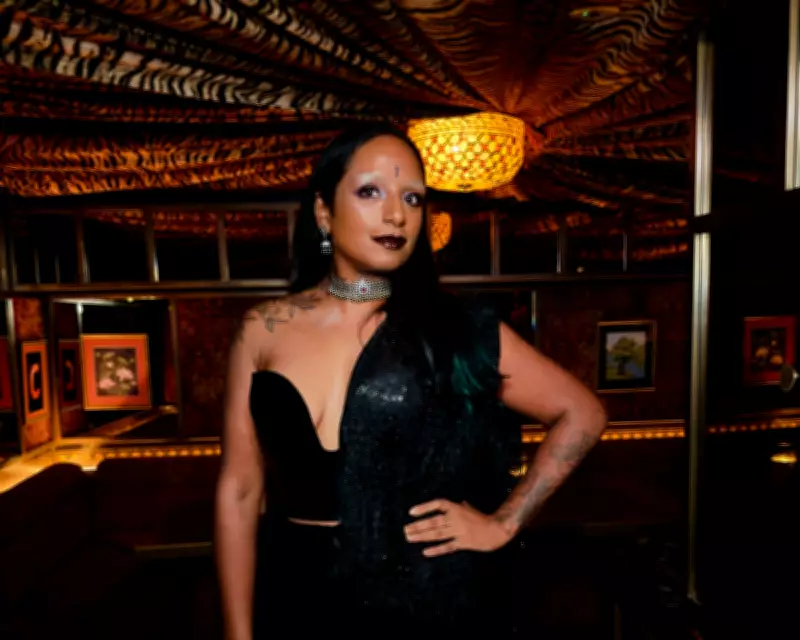
Upon moving to London to work in fashion magazines, Bhagwandas encountered a uniform of studied nonchalance—muted tones and effortless-looking hair—where standing out was frowned upon. She admits to subconsciously assimilating at times, worn down by a culture of pretty privilege and perfectionism. However, an internal itch always pulled her back to her true self. She reconnected with her south Asian heritage on her own terms, pairing black saris with latex tops, visible tattoos, and black lipstick, blending tradition with rebellion.
Beauty as a Litmus Test for Authenticity
For Bhagwandas, beauty serves as an external expression of internal truth, allowing her bold eyeliner or wild hairpieces to speak volumes in place of her soft-spoken nature. It also acts as a litmus test; those who recoil at her bleached brows or red eyeshadow are unlikely to align with her on other matters, providing useful social insights. She argues that fashion and beauty are often dismissed as frivolous but are cultural mirrors reflecting social, economic, and political climates.
Deviating from dominant aesthetics—whether wearing glittery makeup at 60, blue blusher at 40, or letting hair go grey at 30—is a radical act of taking up visual space. Reflecting on her journey, Bhagwandas emphasizes that she chose that awful green mascara simply because she liked it, a reason she believes should be the only one for altering appearance. Now, when faced with aging anxiety or pressure to conform, she reaches for the boldest item in her makeup bag as a private act of resistance, reminding herself not to contort into shapes deemed desirable by others.