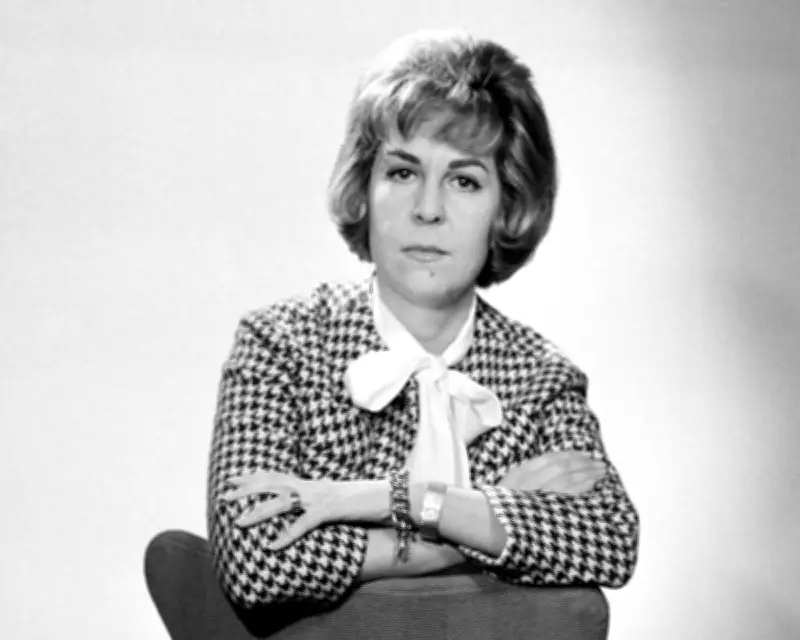
Felicity Green, the innovative journalist who as fashion editor of the Daily Mirror brought the latest 1960s looks to millions of readers, has died aged 100. Green made a career on tabloid newspapers in their most masculine era when, after secretaries and tea-trolley ladies went home, whole buildings could be as all-male as a foundry or a battleship. By 1961 she was an associate editor across Mirror Group newspapers; in 1973, as the group's publicity director, she was the first woman on the main board of a publisher. When she found out in 1978 that a new – less experienced, male – director was paid £30,000 a year, more than twice her salary, she resigned, insulted.
A Career Forged in Tabloid's Male-Dominated Era
Green knew how extraordinary her value had been to the group. The Daily Mirror, at its peak of five million-plus readers, besides being a household's source of news and sport, offered families access to what we would now call pop culture – showbiz, celebrity and especially style. Newspapers were a main advertising medium through the 1950s, 60s and 70s, and agencies yearned for content to attract women, who controlled household purchases, and young people, a new market for discretionary spending.
Green was working at the ad agency WS Crawford in 1955 when Hugh Cudlipp, editorial director of the Mirror Group, asked for her opinion on the Women's Sunday Mirror, a new paper he had launched to appeal to demographics the advertisers desired. She detailed its faults fiercely; he recruited her to its staff. The paper did not last, but Green moved to his Sunday Pictorial (later the Sunday Mirror) and then the Daily Mirror, with overall responsibility for women, and as “Felicity Green on the fashion scene”.

Bringing the Swinging Sixties to the Masses
That was the perfect position at a moment when the long-operating trickle-down-from-the-grand-couture-top process was beginning to be challenged by new designers for customers who had limited money but youth to flaunt. A graphic idea sewn from a couple of yards of cheap cloth and modelled with attitude for, say, David Bailey shooting in black and white could hold a tabloid spread: Green laid out her own pages, integrating text and pictures, inviting participation.
“This is Barbara,” she wrote in May 1964, between a tiny closeup of designer Barbara Hulanicki and a single column shot of Paulene Stone modelling a shortish, sleeveless, gingham shift dress with matching scarf. “And this is one of her designs. Interested? … twenty-five bob isn't a fashion fortune …” Hulanicki expected 3,000 mail orders for the dress, tops. She got 17,000, and so enough money to start her first bricks and mortar Biba shop.
Readers and advertisers responded to the confident sexuality of 60s clothes as shown in Green's pages – a classless look, up from the streets, more at home in the Mirror than Vogue. Green's superiors, though, were apoplectic. The chair of the Mirror, Cecil King, threatened to fire her after a feature on Mary Quant miniskirts, saying, “How long are you going to continue to put those ridiculous clothes in my newspaper? Can you imagine the wife of a Sheffield bus-driver wearing that?”
Trust and Tenacity in the Face of Resistance
Cudlipp was shrewder, telling Green in 1964: “I don't understand what you're doing but I trust you. So I've decided to give you the front and back pages of the Mirror to tell our readers what the swinging 60s are all about.” He did that in 1964: “The Year That Changed Our Lives … Khrushchev sacked, China explodes atomic bomb …” the big print began, eventually reaching, “And of course, skirts got shorter, boys' hair got longer, smart girls wore the trousers …” When she once wore a trouser suit to the office, it was suggested she go home (she didn't.)
Tiny, with a powerful presence and voice, Green personally preferred her clothes undramatic, long favouring Jean Muir, but was amused in later years to buy a clever piece from Zara. She had developed her interest in style during her childhood in Dagenham, east London, when she would skip school at Clark's college, Ilford, every Thursday to go with her father to the cinema to see two movies, especially their wardrobes. He was Emanuel Green, who ran a small shoe shop, and Felicity's mother, Anne (nee Mazin), did not go with them because she was deaf.

Theirs was an unhappy marriage, and Green learned early in life to cope with difficult behaviours. Equipped only with nerve and deplorable shorthand, she begged for a job as secretary, dog walker, coffee maker and lighter of the office coal fire on Woman & Beauty magazine, and found a mentor in its eccentric editor, Phyllis Digby Morton. It was a superior publication, expanding fast with postwar advertising. Green learned about ads, layout and sharp headlines, and – the odd one out among its half-dozen genteel dogsbodies – was promoted to fashion editor.
Navigating Fleet Street and Beyond
Magazines were rife with office politics, but when Green agreed to work for Cudlipp she was surprised at rough life in the Fleet Street bearpit, where there were two daily shifts of drinking, and senior executives kept booze fridges in their offices. She survived initial patronisation and resentment by not registering them, and then got her way publishing pieces on sex, abortion, contraception, equal pay and all the tough topics of the 60s through patience and non-confrontation. Men gave in in the end, she found, if she did not give up. The shortest version of her oft-repeated advice on how to deal with an all-male work meeting is “always allow men to leave the room with their bollocks intact”. But she would not accept any insult to her mastery of the crafts of journalism, or the status they had won her – hence the Mirror resignation.
In the late 70s Green briefly ran the hair stylist Vidal Sassoon's expanding empire, then returned to journalism as an associate editor at the Daily Express in 1980, and the Daily Telegraph from 1986 to 1996. Well into old age she was invited to consult on retail magazines for organisations ranging from Marks & Spencer to Harrods. Her education had been patchy – only that Pitman shorthand certificate – so she was intrigued to teach fashion journalism at Saint Martin's School of Art in London in the 1980s and Central Saint Martins in the 2010s. In 2014 she published Sex, Sense and Nonsense – not the memoir expected from an 88-year-old media dowager, more an anthology of her 60s pages, still blasting the excitement of freedom and a tabloid rawness. She was made an OBE in 2012.
Green encouraged young women who began to join newspaper staffs in the mid-60s as more than just secretaries, saddened that their careers stopped short if they left to have a family. Her own firm belief in equality in all things led her to the Fawcett Society and the 300 Group, which worked in the 80s to increase the number of female MPs. Green married Geoffrey Hill, a cigar importer, in 1952, and he was the rock in her landscape until his death in 1992. She did not regret choosing not to have children, only the consequential absence of grandchildren. Felicity Green, journalist, born 26 June 1926; died 10 September 2026.