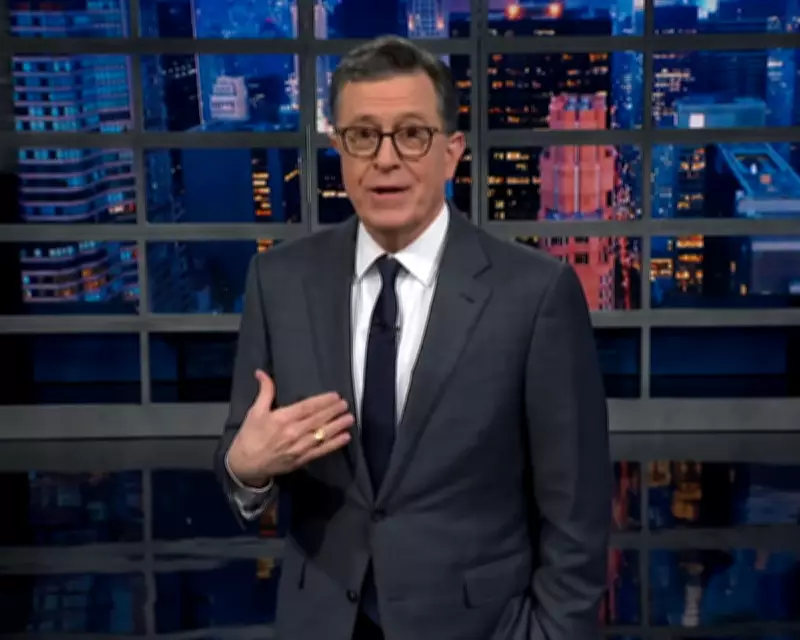
Late-Night Comedians Expose Republican Double-Speak on Iran Military Strikes
In a scathing critique of political rhetoric, late-night television hosts have unleashed a torrent of satire targeting the confusing and contradictory language employed by congressional Republicans to justify the Trump administration's recent military actions in Iran. The comedic commentary focuses on what hosts describe as Orwellian double-speak designed to obscure the reality of escalating conflict.
Stephen Colbert's Thesaurus Jabs
Stephen Colbert opened his Wednesday monologue with pointed criticism, noting the administration's reluctance to use the word "war" despite military actions that clearly constitute armed conflict. "Folks, I really didn't want to start the monologue by talking about the war, but in honor of this administration, I went into this without a plan," Colbert quipped, referencing the coordinated U.S.-Israel bombing that killed Iran's supreme leader, Ayatollah Ali Khamenei.
The host highlighted the White House's distributed talking points instructing Republicans to describe the situation as "targeted, major combat operations" rather than war. "So ... it's worse than a war," Colbert concluded. "It's a war that got a thesaurus for Christmas."

Colbert particularly mocked Speaker Mike Johnson's contradictory statement that Iran "declared war on us. We're not at war right now," responding with a sarcastic analogy about relationship dynamics that exposed the logical inconsistencies in the political messaging.
Seth Meyers on Political Contradictions
Seth Meyers dedicated significant airtime to unpacking what he called "Orwellian circles" of Republican rhetoric. "Republicans in Congress who said Trump would end foreign wars have a new strategy for defending the Iran war: claiming it's not actually a war, even though Trump himself calls it a war," Meyers observed before playing clips of administration officials using euphemistic language like "strategic strikes."
The host identified two primary motivations behind the linguistic gymnastics: avoiding acknowledgment of potential illegality since Congress never declared war, and preventing admission that Trump broke his campaign promise to avoid "forever wars." Meyers characterized the situation as "the absurdity of life inside the Trump cult," where supporters must simultaneously maintain contradictory positions about the nature of the conflict.
Jimmy Kimmel Questions Administration Rationale
Jimmy Kimmel focused on the administration's shifting justifications for military action, noting "team Trump has been throwing out a wide and conflicting array of reasons" for the strikes. Kimmel particularly highlighted press secretary Karoline Leavitt's explanation that Trump acted on "a good feeling" about impending Iranian aggression, asking sarcastically, "He had a good feeling. What more do you need?"
The host questioned why Trump's "good feelings" should justify military action that affects millions, pointing to the administration's inconsistent messaging about whether the strikes aimed to prevent nuclear development, support Israel, achieve regime change, or respond to anticipated attacks.
The Daily Show's Military Critique
Michael Kosta of The Daily Show targeted Defense Secretary Pete Hegseth's aggressive rhetoric during a press conference defending U.S. actions. After playing Hegseth's declaration that "America is winning, decisively, devastatingly and without mercy," Kosta responded, "Whoa, come on, dude – not a fair fight? That's not something you usually hear the good guys say."
Kosta expressed shock at Hegseth's statement that "We are punching them when they're down, which is exactly as it should be," commenting, "Why does the secretary of defense sound like a cheesy movie villain?" The segment highlighted the contradiction between Hegseth's unambiguous war language and congressional Republicans' refusal to acknowledge the conflict as such.
Political Implications of Linguistic Manipulation
The collective comedic critique reveals deeper concerns about political communication and accountability. By refusing to call military action what it clearly represents, Republicans create linguistic loopholes that allow them to avoid difficult questions about legality, cost, duration, and strategic objectives.

Senator Markwayne Mullin's contradictory statements exemplified this approach, telling reporters "This is war" in one breath and "We haven't declared war!" in the next. Kosta joked about this cognitive dissonance, suggesting the senator's first and middle names held opposing views on the conflict.
The late-night commentary underscores how euphemistic language serves political purposes beyond mere communication, functioning as a tool to shape public perception, avoid accountability, and maintain contradictory political positions simultaneously. As Colbert summarized, "No surprise, everyone thinks that this stupid terminology is stupid," yet the terminology persists as a strategic element of political messaging about military engagement.