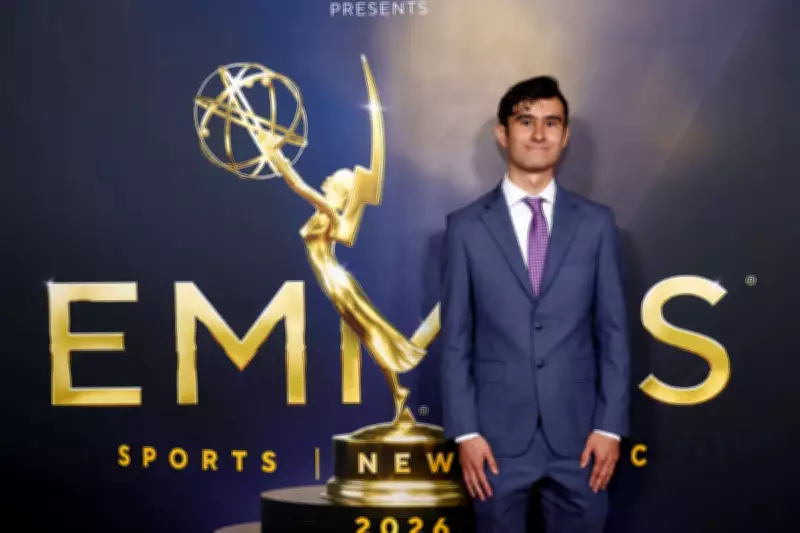
At the 47th annual News and Documentary Emmy Awards in New York City on May 27, 18-year-old high school student Santiago Campos made headlines when he used his acceptance speech for the Mike Wallace Memorial Scholarship to criticize the network that funded it: CBS News.
A Surprise Critique
Campos, a graduating senior from the District of Columbia International School, traveled to New York with his mother and teacher to receive the $10,000 grant, named after legendary interviewer Mike Wallace. The award was presented by veteran 60 Minutes correspondent Scott Pelley, who noted that Wallace would have seen himself in Campos.
While thanking CBS News for the scholarship, Campos launched into a critique of the network's editorial direction under editor-in-chief Bari Weiss and owner David Ellison. 'I want to also acknowledge how the recent direction of the outlet stains the legacy of Mike Wallace, the namesake of this scholarship,' he told the audience.
He continued: 'As corporate elites take hold over the very pipes through which our information flows, journalism that serves the people becomes increasingly harder to come by, yet ever more crucial. And what the people want is the truth. So if at any time you hesitate to utter the word “genocide”, or remain silent in the face of blatant lies, remember to ask yourself: “Who is this for?” I hope you choose us.'
Pelley praised Campos effusively, saying, 'I know that Mike Wallace is looking down on you with pride at this very moment.' The moment quickly went viral on social media.
Campos Speaks Out
Speaking with the Guardian while taking the train back to Washington the next day, Campos said he felt an obligation to speak up despite his gratitude for the scholarship, which he will use to attend Georgetown University in the fall. He admitted he was not familiar with Mike Wallace before applying for the scholarship.
'I knew it was kind of what I had to do,' Campos said. 'I felt like I couldn’t just accept the scholarship and also ignore just how wrong the direction of CBS is going. I was nervous to speak to such a large crowd, but there was never a question about if I was going to say the things I said or not.'
Campos, who does not use Twitter, was aware of the reaction but noted, 'I think it received a lot more attention than I was expecting. I think that that just shows where we are right now and how low the bar is in terms of our expectations of journalists and the mainstream media. I think what I said should be the normal, and so I think we need to get to a place where things like that, and that kind of audacity and integrity is being shown every single day by professional journalists and not by an 18-year-old student.'
His remarks were shared in advance with the National Academy of Television Arts & Sciences, which he said was supportive. 'If Bari Weiss has a problem with what I said and doesn’t want me to receive the scholarship, then she can talk to me,' Campos said. 'But I think most people in the room agreed with me, and I think it was just my responsibility to address my concerns and my qualms and my criticisms of CBS before accepting the scholarship.'
Future Plans
Campos received some job leads after his speech, including an internship offer at a national newspaper, but plans to lifeguard at a county pool this summer. Long term, he is interested in independent, long-form, non-fiction video journalism rather than broadcast television.
'To be honest, I don’t really watch any broadcast [television],' he said. 'I’m pretty disillusioned with the current media environment. And I also think that broadcast is a dying industry. I think that the future is more independent journalism on social media, on YouTube, and so I’m hoping to embrace that new future of journalism.'
In the near future, however, he is more focused on prom and graduation.