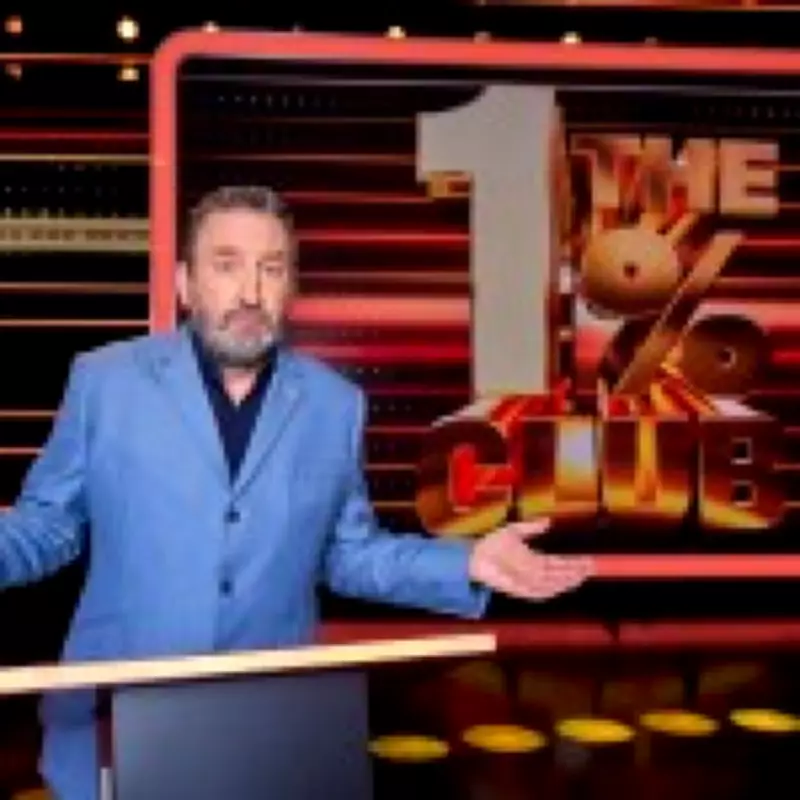
Since its debut in 2022, The 1% Club has captivated audiences with its challenging logic puzzles that demand creative thinking rather than mere general knowledge. Hosted by the witty Lee Mack, the show pits 100 contestants against a series of brain-teasing problems, with the ultimate goal of winning a substantial cash prize.
The Final Question That Stumped Everyone
In a repeated episode that originally aired in May 2025, an impressive five contestants advanced to the crucial final round. They faced a tantalizing opportunity to split a cool £97,000, but only if they could solve a puzzle that reportedly only 1% of the population can answer. Despite their earlier successes, all five finalists failed to crack the code, leaving the prize money untouched.
The Puzzling Word Teaser
The contestants were presented with the following question: "What new word links the capitalised words below?" The sentence read: "My SON TED ate raw FOOD and got SICK, then went to BED with me by his SIDE." The capitalised words—SON, TED, FOOD, SICK, BED, and SIDE—needed to be connected by a common prefix to form new words.
Answers from the contestants included guesses like "well," "you," "step," and "nest," while one player, Peter, offered no answer at all. The correct solution, as Lee Mack explained on the show, was the word "sea." By prefixing "sea" to each capitalised word, you get "season," "seated," "seafood," "seasick," "seabed," and "seaside."
Not the First Time Contestants Have Gone Home Empty-Handed
This incident is not an isolated one in the show's history. In a recent re-run, contestants Christopher and Scott attempted to win a share of £95,000 by solving a puzzle involving triangles. The question asked: "How many triangles are there in this picture?" While the correct answer was 18, Christopher guessed eight, and Scott was close but incorrect with 19.
These examples highlight the show's reputation for presenting deceptively simple questions that can confound even the most logical minds. With only 30 seconds to respond, the pressure adds an extra layer of difficulty, making it a true test of quick thinking under stress.
The Appeal of The 1% Club
Unlike traditional game shows that rely on factual knowledge, The 1% Club emphasizes lateral thinking and problem-solving skills. This unique approach has garnered a dedicated following, as viewers enjoy playing along from home, often finding the puzzles more challenging than they appear.
As the show continues to air, it serves as a reminder that sometimes, even the brightest contestants can fall at the final hurdle, proving that logic and creativity don't always guarantee success in the high-stakes world of television game shows.