Henry Moore's Renovated Sheep Barn Gallery Reopens with Shelter Drawings Exhibition
The Henry Moore Studios and Gardens in Perry Green, Hertfordshire, has reopened its Sheep Field Barn gallery after a major renovation, featuring a new exhibition of Moore's powerful Shelter Drawings from World War II. The exhibition marks a full-circle moment for the estate where Moore created these iconic works after fleeing London bombing in 1940.
From Wartime Refuge to Artistic Sanctuary
Henry Moore and his wife Irina originally moved to Perry Green as a temporary escape from wartime London in September 1940. What began as a refuge evolved into their permanent home and eventually became the extensive cultural ecosystem dedicated to Moore's legacy that exists today. The estate now functions as part minor stately home, part sculpture park, and part archive—one of the largest single-artist archives in existence.
Moore's house, Hoglands, remains preserved exactly as he left it, complete with his personal collections of books, Dogon and Ashanti carvings, a narwhal tusk, and Picasso prints. The property also features amply stocked drinks trays that Moore used when entertaining visitors ranging from Hollywood star Lauren Bacall to German Chancellor Helmut Schmidt.
The Shelter Drawings: Artistic Response to Conflict
The centerpiece of the reopening is an exhibition of Moore's Shelter Drawings, created while he served as a war artist during the Blitz. These powerful works depict Londoners sheltering in underground stations, capturing moments of collective vulnerability and resilience. According to Lesley Wake of the Henry Moore Foundation, Moore was so sensitive to his subjects that he avoided photographing or directly sketching them, instead taking notes and drawing from memory.
"The Shelter Drawings established Moore's reputation and are central to understanding his response to conflict," Wake explains. "He was essentially drawing sculptures when he created these human forms emerging from the shadows of the underground shelters."
Architectural Transformation of the Sheep Field Barn
London-based architecture firm DSDHA has reimagined the Sheep Field Barn, originally a 1970s steel-frame structure used by Moore to store materials and sheep fodder. The building was first converted into a gallery space in 1999, but the latest renovation adds new sections to the north and east sides while enclosing them under a sloping roof that reduces the building's monolithic appearance.
"We wanted to maintain the feeling of Moore's time here while meeting contemporary visitor expectations," says DSDHA director David Hills. The redesign uses reclaimed silver spruce timber from the original building and incorporates sustainable features including sheep's wool insulation, triple-glazed windows, and solar panels. Despite doubling in size, the renovated building consumes half the energy of the original structure.
Educational Spaces and Moore's Creative Legacy
The expanded gallery now includes dedicated spaces for art education, reflecting Moore's passion for teaching. The foundation hosts over 2,000 schoolchildren annually for free visits, and the new workshops will enhance these educational programs. "Children explore the grounds, collect materials, and create inspired work just as Moore did," Wake notes.
Across the estate, Moore's various studios remain preserved as he left them, with tools and works in progress still in place. His maquette studio contains a fascinating collection of models, stones, wood, feathers, bones, and even an elephant skull—all materials that inspired his creative process.
Sheep and Sculpture: An Enduring Relationship
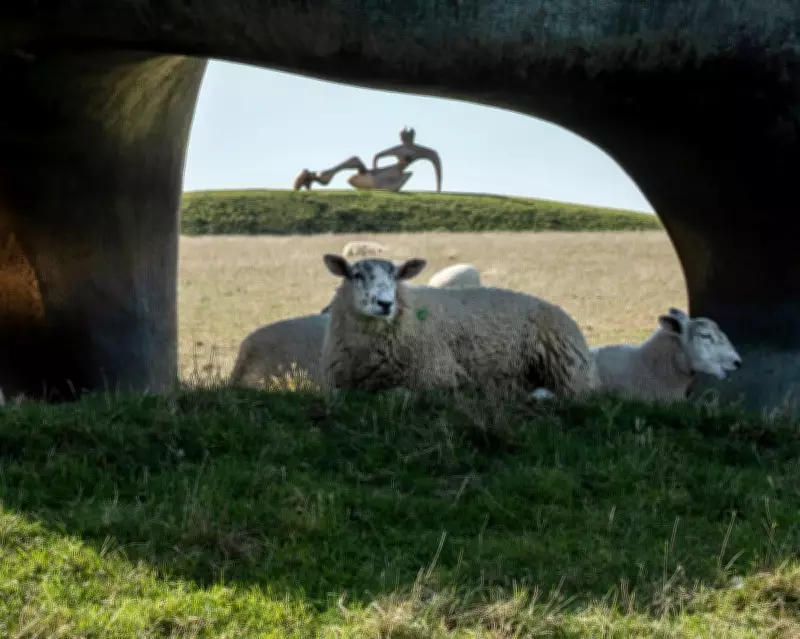
The estate's sheep continue to play a significant role, grazing in fields among Moore's monumental sculptures. Moore would famously tap on his studio window to attract sheep for drawing sessions, and these ovine subjects inspired his famous bronze sculpture Sheep Piece. When placed in Perry Green's fields, sheep would use the sculpture for shelter and as a scratching post.
The renovation's use of sheep's wool insulation provides a fitting tribute to this relationship. "Moore was a recycler before the term was coined," Wake observes. "He embraced frugal innovation and used everything he had."
Moore's Enduring Relevance
With the Sheep Field Barn reopening and a major exhibition scheduled at Kew Gardens in London from May 2024 to January 2027, Henry Moore is experiencing renewed attention. Despite early controversies that saw his sculptures vandalized in various locations, Moore eventually became recognized as a national treasure who fundamentally transformed British sculpture.
"Art is the expression of the imagination, not the reproduction of reality," Moore once declared—a philosophy that continues to resonate through his preserved estate and the newly renovated gallery that celebrates his enduring legacy.