Michaelina Wautier Review: An Astounding Lost Artist Steps Out of Her Male Contemporaries' Shadows
Art history is currently undergoing a profound revision, actively uncovering overlooked female artists to challenge the traditional white male canon. In this transformative movement, the extraordinary work of Artemisia Gentileschi has recently surged in popularity, with major exhibitions striving to highlight her artistic achievements beyond the tragic sexual assault that often overshadows her biography. Now, UK audiences are introduced to another remarkable figure: Michaelina Wautier, a 17th-century trailblazer whose mighty paintings have been misattributed to her male peers for over three centuries.
Unveiling a Hidden Master
Michaelina Wautier, born around 1614 in Mons in the Spanish Netherlands (present-day Belgium), lived with her artist brother Charles in Brussels near the royal court. Unlike Gentileschi, scant documentary evidence exists about Wautier's life, adding to her enigmatic presence. Both artists share a commonality: their technical brilliance flourished in a patriarchal society that severely restricted women's opportunities for successful artistic careers. Consequently, their works were automatically attributed to male counterparts, such as Wautier's brother Charles or other contemporary baroque painters, obscuring their contributions for 300 years.
Wautier's elusiveness is further compounded by her mastery across multiple genres, all executed with consistent quality. She excelled in portraits, history or religious painting, and decorative floral work—the latter more commonly associated with female artists. This versatility made identification challenging, as her diverse output defied easy categorization.
The Triumph of Bacchus: A Monumental Revelation
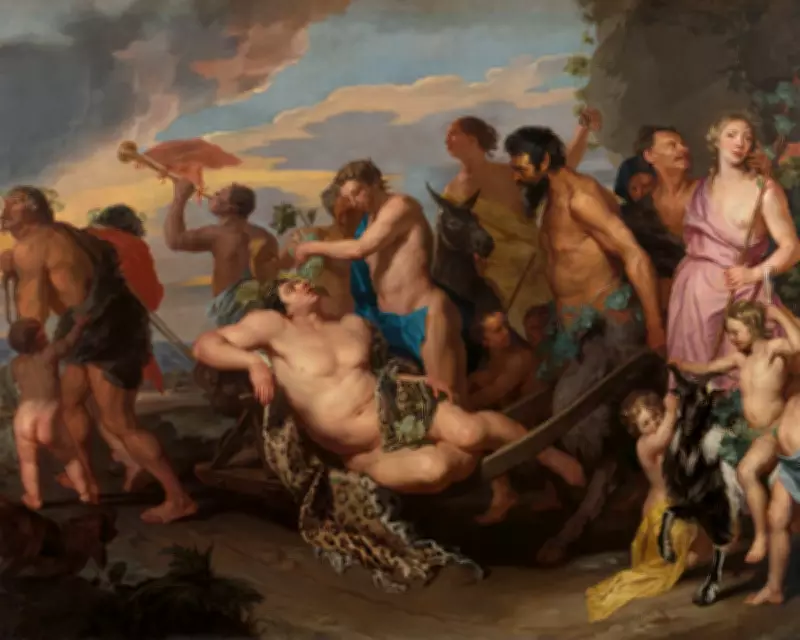
In 2009, a pivotal moment occurred when The Triumph of Bacchus, a monumental canvas, was first definitively attributed to Michaelina Wautier at the Kunsthistorisches Museum in Vienna. This painting now features prominently in the Royal Academy's exhibition, showcasing the latest iteration of Wautier's evolving oeuvre. Its grand scale and ambitious composition, intertwined with swathes of nude anatomical flesh, seemed improbable to generations as the work of a woman. Historically, women were denied access to art classes and live models, raising the question: how could she have achieved this so effortlessly? Intriguingly, Wautier painted her own face into the scene, a bold statement of authorship.
Art Historical Investigation in Real Time
The exhibition serves as a rare example of an art historical investigation unfolding in real time, employing three pillars: scientific analysis, scholarship, and connoisseurship. For instance, of only two known garland paintings by Wautier, one was painted on a wood panel embossed with an Antwerp mark, providing geographical context. It also features unusual imagery of ox skulls, a motif seen on ancient Roman urns. In her only known drawing, Wautier studies the Medici Ganymede bust, then located in Rome. This raises questions: did she have the financial means to visit Italy, or did she encounter such visual references through social connections?
Connoisseurship—the identification of artistic authorship by sensing a characteristic painterly feel—plays a crucial role in this exhibition. Experts, with decades of experience in visual memory, argue that while unquantifiable, this method is essential. Auction houses and galleries often favor the safer conclusions of science and scholarship, but these are incomplete without the intuitive insights of connoisseurship.
Stylistic Comparisons and Revelations
The exhibition's layout powerfully supports this approach. The first two galleries display portraits and religious paintings by Wautier, interspersed with works by her contemporaries like Rubens and her brother Charles. The third gallery focuses on her most distinctive works, allowing for pure stylistic comparison. This arrangement reveals that Michaelina and Charles likely shared a similar technical education, perhaps the same studio and materials. Curators even suggest that Michaelina's hand may have contributed to some of her brother's works, highlighting her collaborative yet overshadowed role.
A Joyful Discovery of Distinctive Art
The room dedicated solely to Michaelina Wautier's works is a joy to behold. Her paintings are described as most distinct not only for their baroque style but also for their quintessential uniqueness. Note her particular fondness for wild and loose locks, which adds a personal touch. Her art is full of luminosity and vivacity, often piqued by a subtle sense of humor. For example, her Five Senses series subverts traditional depictions: in Smell, instead of a woman delicately sniffing a flower, a grimacing boy recoils from a rotten egg, nose scrunched in disgust.
Raising Awareness for Future Discoveries
This exhibition marks the first encounter with Michaelina Wautier's work for many UK audiences. By grouping all her known works together—previously almost nonexistent in the collective imagination—the show conjures an entirely new persona: an astonishing artist of exceptional, fully formed ability. Importantly, it raises awareness to continue efforts in uncovering further misattributed or lost paintings. The story of Michaelina Wautier is far from over, promising more revelations in the ongoing quest to rewrite art history.
Michaelina Wautier is at the Royal Academy, London, from 27 March to 21 June.