Hurvin Anderson's Haunted Retrospective Explores Identity at Tate Britain
A major retrospective of Hurvin Anderson's work is currently captivating visitors at Tate Britain in London, offering a profound exploration of the artist's Black British and Jamaican heritage through a series of dreamlike, unresolved paintings. The exhibition, which runs from March 26 to August 23, presents Anderson's figurative works that grapple with themes of memory, belonging, and identity with a startlingly fragile intensity.
Clashing Contrasts and Unresolved Conflicts
Anderson's world is defined by stark contrasts: us and them, then and now, concrete and jungle, acceptance and rejection. These conflicts, rooted in his experiences growing up in Birmingham and his Caribbean heritage, are central to his artistic practice. His washed-out, hazy, and heat-drenched paintings serve as an attempt to make sense of a senseless world, though they often leave viewers with more questions than answers—a deliberate and powerful choice that underscores the complexity of his themes.
In the 1990s, Anderson began painting from family snapshots and found photographs, transforming them into ethereal scenes where figures seem to melt into their surroundings or slowly turn into ghosts. For instance, a woman in a patterned dress blends into the wallpaper behind her, while his adult sister sits beside her childhood self, blurring the lines between past and present. This approach highlights how photographs promise nostalgic truth, only to collapse under the weight of Anderson's painterly reinterpretation, making geographic and temporal distances feel intangible.
Sanctified Spaces and Political Undertones
One of the few places where conflict momentarily halts in Anderson's work is the barbershop, depicted as a sanctified space where Black people can belong without rejection. He paints these scenes both empty and serene, like a church, and occupied, with clients' faces reflected in mirrors and walls adorned with images of Martin Luther King Jr. and Malcolm X. A solo portrait shows a man alone in a barber's chair, head bowed as if in prayer, emphasizing the spiritual significance of these environments.
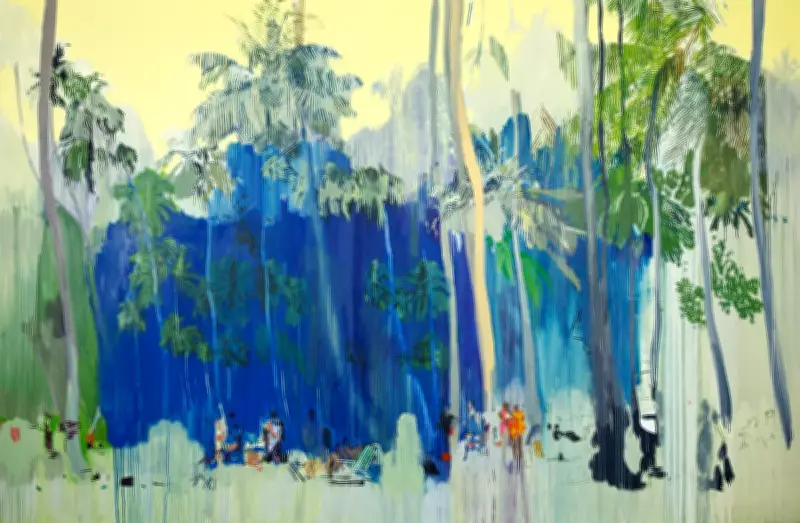
Later, Anderson shifts from the grim, grey landscapes of England to the lush, humid beauty of the Caribbean, yet oppression persists. During visits to Trinidad and Tobago in the early 2000s, he observed iron security grilles and chain-link fences that framed views while excluding outsiders. His paintings of country clubs behind fences and hotels being reclaimed by the jungle reinforce themes of division and collapse, with colonial history haunting the post-colonial present. Unlike artists like Peter Doig, Anderson's work is not merely emotional but deeply political, addressing slavery, colonialism, and clashing identities that haunt both the Caribbean and Britain.
Reprocessing Memories Through Art
Throughout the exhibition, Anderson reworks the same themes and images—such as barbershop scenes, red security grilles, and a woman against wallpaper—creating a sense of stumbling through someone else's memories. This repetition reflects how memories evolve as the artist himself changes, reprocessing childhood experiences like leisure centres or libraries over time. In one striking example, he paints an apple tree superimposed on a mango tree, imagining his brother scrumping for fruit in both England and the Caribbean, symbolizing the fragility of identity.
Anderson's technical prowess is equally compelling, blending geometric modernist blockiness with washes of dripping, gestural colour. He smashes free-hand figuration into minimalist grids, as seen in a series of five paintings depicting the same concrete staircase in a mutating jungle. Viewers can lose themselves in the vibrant marks, colours, and hues—bright blues, throbbing purples, and deep greens—that anchor the unresolved sense of conflict in his work.
Ultimately, this retrospective at Tate Britain showcases Anderson's ability to create hauntingly beautiful paintings that resist easy resolution, inviting audiences to engage with the ongoing struggles of identity and history. The exhibition is a must-see for anyone interested in contemporary art, cultural heritage, and the power of visual storytelling.