Frank Bowling: Seeking the Sublime – A Journey Through Artistic Liberation
The Fitzwilliam Museum in Cambridge presents a compelling exhibition titled Frank Bowling: Seeking the Sublime, running from March 27, 2025, to January 17, 2027. This illuminating showcase traces the remarkable evolution of British Guyanese artist Frank Bowling, from his early socially conscious paintings to his groundbreaking abstract works that challenge artistic boundaries.
The Early Struggle: Navigating Artistic Expectations
In 1961, when Bowling created his earliest works featured in this exhibition, the art world operated within rigid categories. Artists were expected to choose between political engagement or formalist purity, between European or American traditions, and between being labeled as a "Black artist" with specific representational duties or simply as an "artist" – a privilege typically reserved for white male creators. The young British-Guyanese painter found these restrictive options deeply unsatisfying.
Early works like 4 Horsemen of the Apocalypse, created during his time at London's Royal Academy, demonstrate his initial attempts to conform to institutional expectations. This chaotic composition features a screaming black face amid tortured bodies, with wall text linking it to the 1961 murder of Patrice Lumumba, the former prime minister of what is now the Democratic Republic of the Congo. Similarly, Beggar No 5 (1962–63) shows heavy indebtedness to Francis Bacon's style, suggesting a potential career path as a Caribbean artist focusing on themes of "cane-cutting and suffering," as Bowling once described it.
The Turning Point: Finding Authentic Expression
Despite these early efforts, these paintings ultimately fail to resonate fully. The borrowed styles prove incompatible with Bowling's emerging artistic voice. A pivotal moment arrives with Swan (1964), a small but powerful painting that captures a flailing white form trapped within an iridescent grid between two flat planes.
This work operates on multiple levels simultaneously. As pure abstraction, its discordant forms, brittle colors, and claustrophobic composition effectively convey panic and imprisonment. When contextualized by its title and inspiration – Bowling witnessing a swan trapped in an oil slick on the Thames – it transforms into a symbolic narrative about migration, transformation, and the struggle against imposed identities. The painting's dual nature demonstrates that no single interpretation need exclude others, a realization that would fundamentally shape Bowling's artistic philosophy.
Transatlantic Transformation: The New York Liberation
By 1966, Bowling reached an artistic impasse that demanded radical change. His escape to New York marked a profound transformation in his approach to art. The artist who had once written to critic John Berger about wanting to "paint my people: that is black people" became a disciple of Clement Greenberg, who championed art as a purely aesthetic realm divorced from politics, identity, or personal biography.
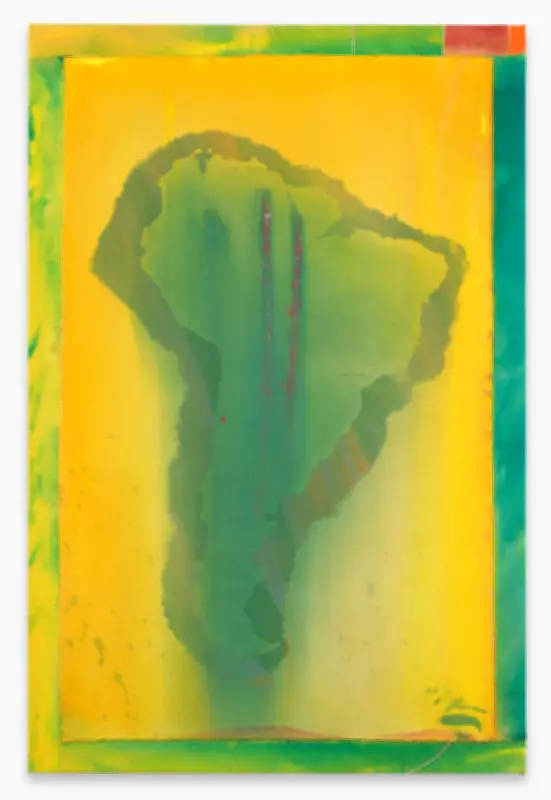
This shift proved enormously liberating, as evidenced by the magnificent 1976 painting Lenoraseas. This vertical composition of poured paints in variegated pinks, yellows, whites, and purples showcases Bowling's exceptional gifts as a colorist. Yet the work transcends mere optical pleasure through its physical texture – a mountainous terrain created by paint flow – and its title's reference to Lenora, Guyana, where the Essequibo River meets the Atlantic Ocean.
Lenoraseas embodies Bowling's mature artistic vision: simultaneously an abstract painting, a river landscape, a connection to sublime traditions from Constable to Turner, and a document of personal and ancestral history. It demonstrates Bowling's recognition that a work of art can encompass multiple meanings and identities simultaneously.
Masterful Synthesis: Pondlife and Artistic Maturity
The exhibition's most remarkable work, Pondlife (After Millais), transforms John Everett Millais's famously narrative-heavy Ophelia into a hazy, humid, impressionistic atmosphere. Bowling's technically sophisticated handling dissolves greens into blues and reds into golds, creating a mesmerizing visual flow.
Yet this atmospheric beauty contains deliberate impurities. The drowned Ophelia has been replaced by found objects – fabric patches with serrated edges, what might be bolts or bottle tops – painted onto the canvas surface. The effect suggests wreckage from a shipwreck, dredged up by a storm. Like the bodies of water that frequently inspire his work, Bowling's finest paintings resist fixed identities, connect disparate cultures and places, carry suspended histories, and defy easy categorization.
Through this carefully curated exhibition, visitors witness Bowling's journey from an artist struggling with imposed categories to one who creates works that transcend them entirely. His paintings become spaces where personal history, social commentary, formal innovation, and pure aesthetic pleasure coexist without contradiction.