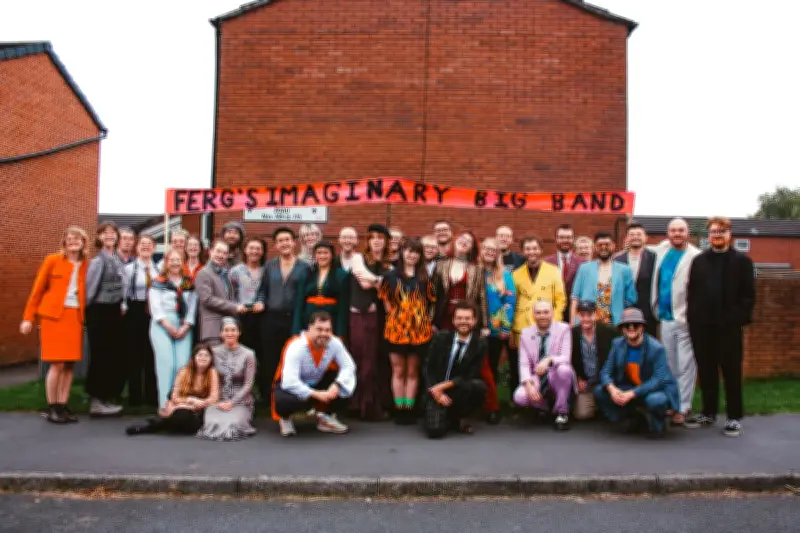
Fergus Quill picks up a visitor from Leeds station in his Nissan Micra, double bass expertly slotted between seats, and drives to meet his band. Over the next half hour, members of Ferg’s Imaginary Big Band (FIBB) keep arriving until the tables outside Headingley’s Hyde Park Book Club overflow with musicians and instrument cases. When rain starts, they shuffle indoors and begin playing noisy, joyful music in the bar’s snug room.
41 Musicians and Counting
Forty-one musicians play on FIBB’s second album, The New Atomic, though gigs usually feature about 30. There was one early gig where they compromised on size. “Never again,” says saxophonist Bess Shooter. Even with a svelte 10-piece, their principles shine through. “I’d say we’re pretty traditionalist,” Quill says, though in their hands, tradition sounds radical. In the snug, they play a tribute to late US trumpeter Jaimie Branch and songs from their new album such as I Shall Not Be Moved, which brims with angry fire.
Rooted in Tradition, Radical in Practice
FIBB are rooted in principles of revered bandleaders like Duke Ellington and Count Basie: saxophones, trumpets, and trombones backed by a rhythm section, playing imaginatively scored ensemble sections that expand into individual solos. But FIBB are more in a lineage of big band dreamers, from Loose Tubes to Sun Ra to Charlie Haden’s Liberation Music Orchestra: queer-friendly, anti-fascist, and sprawling, quite different from refined orchestras of the big band mainstream. Their sound is rough and brazen, but not without playfulness. For example, Play the Names features a discordant opening chord collapsing into band members yelling their names in frantic sequence, voices coming together to spell F-E-R-G before messy instrumental chaos returns over a bustling funk figure.
Embracing Chaos and Imperfection
To be in the band, Quill says, “you don’t have to be the strongest sight-reader, but you do have to have an independent musical voice.” Top improvisers play with people who don’t read music, who play with members who can’t even play instruments but join in wholeheartedly. “We embrace chaos, imperfection and all that,” pianist Nico Widdowson adds, “but we all want to be the best musicians that we can be.”
The New Atomic: A Vehicle for Sincerity and Whimsy
The New Atomic is the perfect vehicle for FIBB’s idiosyncratic blend of sincerity and whimsy. Despite many references—wailing New Orleans funeral marches, Bob Dylan covers, odes to Ellington, punk, and Cold war-era musical anxiety—there’s a powerful G-force as this enormous unit swings from idea to idea. The band isn’t yet 10 years old, but its history already resembles that of the Fall, another band with a talismanic frontman. “If it’s me and your nan on bongos, it’s Ferg’s Imaginary Big Band,” says Quill, the bass player, main composer, and leader, wrangling chaos from the front.
From Pub Chats to Ronnie Scott’s
The name began “as a figure of speech,” drummer Josh Ketch says; pub chats regularly returned to Quill’s plans for a behemoth big band. Out of a music college Sun Ra project in 2018, gigs grew steadily, stymied only briefly by Covid. They’ve played at Ronnie Scott’s and Love Supreme festival, and thanks to a convoy of nine-seater minibuses and one “wally car” (for those running late), they’ve toured the UK. Their continued existence is a testament to Leeds and its spaces: venues like Book Club, Brudenell, or Domino, and spaces like Attic and Eiger Studios for fortnightly Monday rehearsals. “I rarely pay over £30 for a rehearsal space,” Quill says. Could FIBB happen anywhere else in the UK? “It has to happen in a place where the rent is under £500 a month,” Quill replies. “Otherwise, I don’t think you could get people to commit to this thing, or have the time to do it.” Nobody makes money from the band, but musicians, librarians, charity workers, bar staff, and teachers manage to make it work.
Quill’s Journey: From Neurodiverse Kid to Bandleader
Back in the Micra, Quill points out FIBB affiliates who couldn’t get time off work. He has always felt best living outside nine-to-five strictures. In his youth in Essex and later Saffron Walden, Quill was “in and out of mainstream education.” He loved music but never got on with graded exam systems. An inspirational teacher gave him an early crash-course in jazz, and his parents were extremely supportive. “I was a neurodiverse kid with additional educational needs,” he says. “When it was decided that I was interested in music, they just laid out instruments in the house, and I went between them. I was always just allowed to play.” Moving from a Quaker boarding school to state sixth form, Quill found people playing “squeaky clean hardcore punk, so I did some of that.” He was drawn to outsiders—his favourite musician was early 20th-century American experimentalist Charles Ives—and teachers gave him more: Lou Reed, Charles Mingus, Frank Zappa. He didn’t plan to go to music college: “I was making all right money being a magician at Freemason events, and then busking on the street.” But when friends moved away to university, he rang up music colleges. Stressing he could double on electric and upright bass, Leeds College of Music accepted him after he recited chords to Horace Silver’s Song for My Father down the phone. “I didn’t do an audition or anything,” he says. “I don’t think you could get away with that now.” At college, he quickly found Hamish Dixon, a constant in the FIBB universe, whose role is simply “noise.” They’ve lived together for 11 years.
Punkish Energy and Collective Unlearning
There’s a punkish energy to FIBB, involving collective unlearning of things the jazz world taught them. “When I was younger,” Shooter says, “there was so much in the scene about never doing anything for exposure, or for no money. Now, there’s a whole load of people like us, getting together to make stuff just because they want to.” The day ends at the local Hollywood Bowl, a regular hangout. Quill recently turned 30, prompting reflection on a chaotic past decade. “For a long time I was actually quite unhappy, quite ill, but was putting that to the side because I just had this drive to create things.” For a while, bowling was his only “outside” from an all-consuming musical life. With time, balance has come by embracing sociability, rejecting “a CV-driven career,” and realizing his role as a caregiver to a band with ages spanning 30 years. “It’s great – now I’ve got kids in my band, I can try to have a well-rounded life,” he says. He’s moving into a housing co-op; he’ll continue to write music; they’ll tour again soon. The big band dream continues. The New Atomic is released 26 June via Trash City Records.