Donald Towner's Hampstead: An Artist's Timeless Vision of London's Changing Landscape
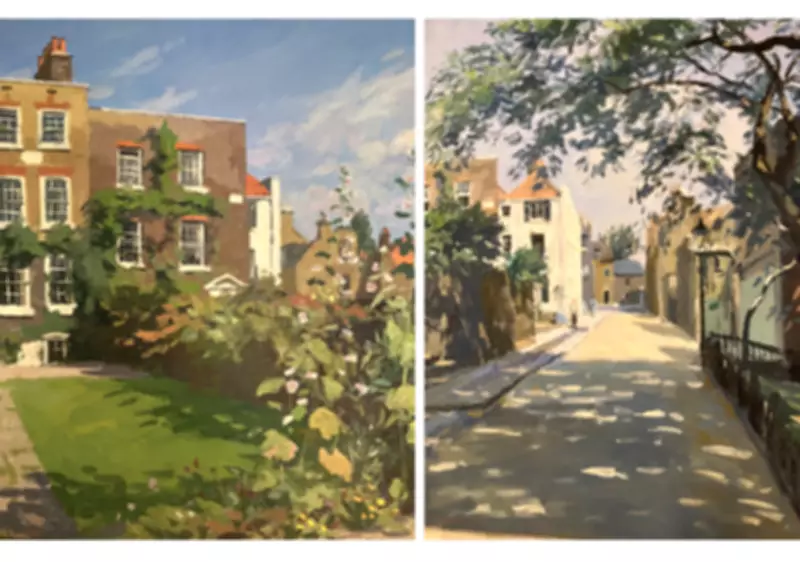
A new exhibition at Burgh House celebrates the remarkable artistic legacy of Donald Towner, an Eastbourne-born painter who found his creative home in Hampstead for six transformative decades. Amongst the Trees and Terraces: Donald Towner (1903–1985) showcases works spanning from the interwar period through postwar London, revealing how Towner captured both the enduring beauty of the English countryside and London's rapid transformation on the cusp of Modernism.
From Eastbourne Countryside to London Streets
Born in 1903 in Eastbourne, Towner's artistic journey began in childhood, armed with wax chalks that melted in the sun as he painted poppies in cornfields. His early years were marked by solitary walks across the South Downs, where he developed what he called "a natural talent" for landscape painting. This foundation would shape his entire career, even as he transitioned from rural watercolors to urban oils.
Towner's formal training began at the Eastbourne School of Art, where he met lifelong friend and fellow artist Eric Ravilious. Their shared journey continued at the Royal College of Art in 1923, where Towner embraced architectural studies that would later inform his precise depictions of London's built environment. This educational background gave him unique perspective on how to capture both natural and man-made landscapes with equal sensitivity.
Finding Home in Hampstead
In a pivotal moment, Towner's mother suggested he investigate "a little village outside London called Hampstead." He discovered No 4 Holly Hill, purchasing it for £1,750 and establishing a Heath Street studio beneath cartoonist David Low. This move marked the beginning of his six-decade relationship with NW3, during which he witnessed and documented profound changes to the area.
Towner developed innovative methods for capturing London's urban landscape, seeking "secluded spots away from people and traffic" where he could find compelling subjects. He obtained permission to paint from rooftops and empty building windows, creating remarkable views of Covent Garden Market from the National Sporting Club and capturing St Bride's Church in Fleet Street with architectural precision.
The Hampstead Studio and Garden Inspiration
As his mother aged and found Holly Hill's steps challenging, Towner moved to Church Row, where he would remain until his death in 1985. His back garden became both sanctuary and subject, featuring a magnolia tree he nearly removed until Vita Sackville-West famously advised: "One must never destroy a magnolia." Two pear trees thrived there, with Camden Town market men collecting barrowloads each autumn.
This well-tended garden inspired numerous paintings, while Towner's commercial work took unexpected turns. When the proprietor of Louis's Patisserie on Heath Street unexpectedly commissioned a large Hampstead scene, Towner creatively combined two older paintings of the Vale of Health pond and adjoining Heath areas, adding anglers to create a composite that satisfied the baker's request for "buildings, water, trees, grass and people."
Artistic Philosophy in Changing Times
In his 1970s autobiography, written during "winter evenings or when the daylight was too poor in my studio for me to paint," Towner reflected on living through what he called "the most momentous three quarters of a century man has ever known." He observed painting undergoing "innumerable changes of style" while maintaining that the fundamental elements of nature remained constant sources of inspiration and joy.
Towner's work represents a bridge between tradition and modernity, capturing both the "changefulness of material things" and the "changelessness of nature." His Hampstead paintings serve as visual records of an NW3 that has transformed dramatically, yet through his art, certain essences of place and time remain preserved for contemporary viewers.
The exhibition at Burgh House offers visitors opportunity to experience Towner's unique perspective on London's evolution, from his early countryside scenes to his mature urban landscapes. It reveals how one artist maintained his distinctive sensibility while adapting to changing artistic movements and a rapidly transforming city.