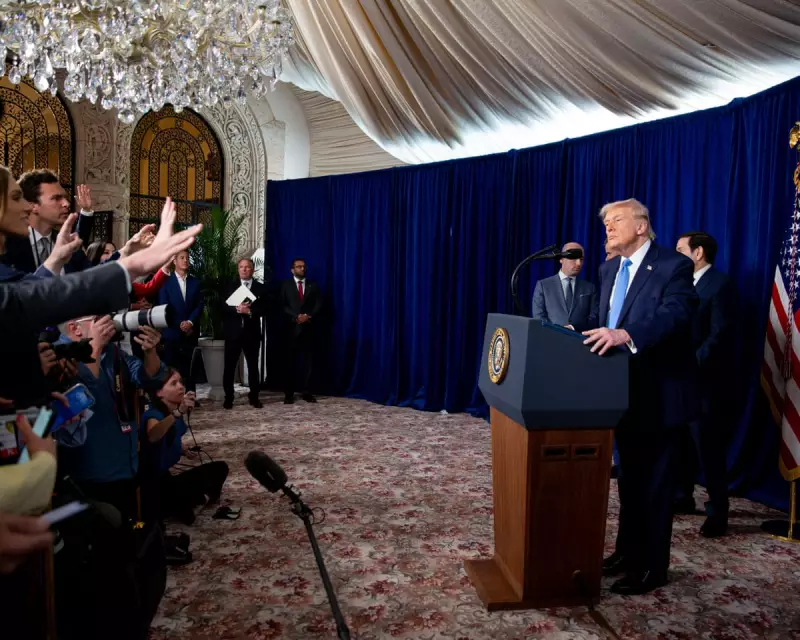
In a lengthy press conference on Saturday, former US President Donald Trump surprised observers by placing Venezuela's vast oil reserves at the centre of his rhetoric, while making scant mention of the 'war on drugs' that had previously been his primary justification for military action in the region.
Shift in Narrative Raises Eyebrows
Hailing the US operation to capture Venezuelan President Nicolás Maduro as "spectacular" and "an assault not seen since World War II", Trump devoted significant time to discussing oil. He referred to the commodity more than a dozen times during the hour-long event, often introducing the topic unprompted by questions. This marked a stark departure from the months-long narrative framing the build-up and naval strikes—which have resulted in 116 fatalities—as part of a counter-narcotics campaign.
Trump's insistence ended up bolstering a long-held claim from Caracas: that the ultimate US objective was regime change and control over the country's natural resources. "We built Venezuela's oil industry with American talent, drive and skill, and the socialist regime stole it from us," Trump asserted, echoing a social media post from his former homeland security adviser, Stephen Miller, from mid-December. He characterised this as "one of the largest thefts of American property" in US history.

Legal Experts Dispute Claims of 'Theft'
However, legal and energy analysts have been quick to challenge the foundation of Trump's statements. José Ignacio Hernández, a scholar specialising in Venezuela's oil sector, clarified the position: "Even if a past government illegitimately expropriated the oil assets of US companies without fair compensation, Venezuela did not steal any oil from the US."
The historical context is complex. US firms began drilling in Venezuela in the early 20th century, but they held concessions, not ownership of the oil or land. The principle of permanent sovereignty over natural resources, established by the UN in 1962, grants states control over resources within their borders. Venezuela nationalised its industry in 1976 under President Carlos Andrés Pérez, creating the state-owned PDVSA. While US companies like Exxon and Gulf Oil (now part of Chevron) incurred losses, they received compensation.
A later wave of nationalisation occurred in 2007 under Hugo Chávez. ExxonMobil and ConocoPhillips rejected new terms and had assets seized, subsequently winning international arbitration awards. ConocoPhillips is still owed more than $10 billion. Francisco J Monaldi of Rice University's Baker Institute notes this debt makes the company a key player in any future negotiations regarding Venezuela's oil.
A Broken Industry and a Complex Future
Despite holding the world's largest oil reserves, Venezuela's production is a shadow of its potential, crippled by mismanagement, corruption, and US sanctions. Output sits at under 1 million barrels per day, less than 1% of the global total. Monaldi estimates a return to potential production of 4-5 million barrels would require $100 billion in investment and over a decade.
Current operations are split between PDVSA (roughly 50%), Chevron (about 25%), and joint ventures led by China, Russia, and European firms. Sanctions under Trump and a temporary easing under President Joe Biden have further complicated the landscape. Some analysts argue the sanctions themselves hindered Venezuela's ability to pay compensation owed to US firms.
Chevron maintained a reduced presence throughout. Trump's recent order allows the company to use royalties to cover operating costs and pay down Venezuelan debt, rather than fund Maduro's regime. Monaldi suggests Chevron is best positioned to benefit if sanctions are lifted, but warns "the Venezuelan state companies are effectively broken."
Trump's reframing of the Venezuela conflict around oil, experts conclude, exposes the geopolitical and economic stakes that have likely underpinned US policy all along, moving beyond the initially stated goal of combating drug trafficking.