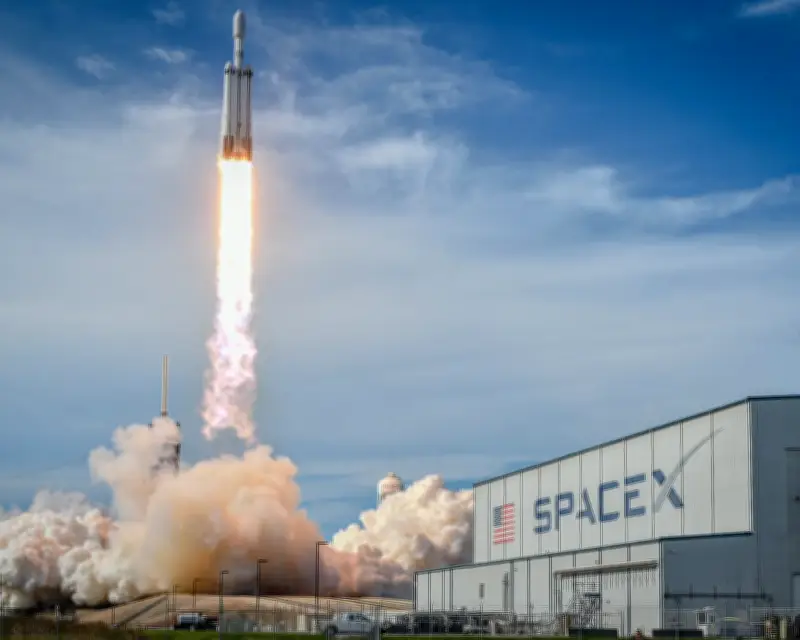
SpaceX achieved the largest stock market debut in history on Friday, ending nearly 25 years as a private company. With a valuation of $1.77 trillion, the initial public offering is expected to make CEO Elon Musk the world's first trillionaire.
Musk's Vision for Multiplanetary Life
"It is certainly hard to believe that a little company that started in a warehouse in El Segundo is now going public with the largest IPO ever," Musk said at SpaceX headquarters. He reiterated the company's mission to "make humanity multiplanetary" and "take the fiction out of science fiction."
Executives rang the opening bell as Elton John's "Rocket Man" played on the Nasdaq exchange floor. "Today, we make history again. We have a history of making history," said SpaceX President Gwynne Shotwell.
Musk's Path to Trillionaire Status
Musk, SpaceX's founder and majority shareholder, holds a large stake. If investor enthusiasm validates the valuation, he could become the world's first trillionaire. He also leads Tesla, valued at $1.2 trillion, with his stake worth about $300 billion.
SpaceX's IPO comes in a predicted banner year for AI company public offerings. The rocket maker acquired Musk's AI startup, xAI, and rivals OpenAI and Anthropic have also filed to go public, potentially raising record sums near $1 trillion.
Capital for Space Exploration
Musk stated SpaceX seeks to go public to raise capital for space exploration and creating human colonies on other planets. "Our mission is to build systems and technologies to make life multiplanetary, understand the universe, and extend consciousness to the stars," SpaceX said in its investor prospectus.
SpaceX combines several Musk businesses, including satellite maker Starlink, xAI, social media platform X, and the rocket business. However, the company is not profitable. Last year, it generated $18.7 billion in revenue but recorded an operating loss of $4.3 billion. In comparison, Meta earned over $200 billion in revenue with a net income above $60 billion.
Unusual IPO Terms
SpaceX's IPO features unusual terms: a fixed share price of $135 instead of a customary range. Buy-in relied on investor enthusiasm at that price. SpaceX stopped taking orders on Wednesday. Reports indicated investor demand was up to four times oversubscribed, potentially raising $250 billion instead of the planned $75 billion. Senator Elizabeth Warren called on the SEC to delay the IPO over potentially "inaccurate or misleading accounting or valuation."
Market watchers are on high alert. Analysts note the lack of profitability, cash burn on AI buildout (xAI spends heavily on datacenters), and Musk's control of roughly 85% of voting shares could make for a volatile asset.
Impact on Employees and Economy
The debut could bolster SpaceX's grip on the financial system. Shares will reportedly be distributed into index funds shortly after the IPO, faster than typical, though not into the S&P 500. This could expose retirement savings to risk if the share price plummets.
For employees, the valuation means great wealth. Over 4,400 current and former employees are expected to become millionaires, with 400 securing $100 million or more, according to the New York Times.
Economist Gabriel Zucman warned that consolidated capital from SpaceX, OpenAI, and Anthropic IPOs could have profound effects. "There is a fundamental tension between extreme wealth and democracy," he said. "After WWII, extreme wealth seemed past, but the AI boom is minting billionaires daily, and trillionaires are coming into view."