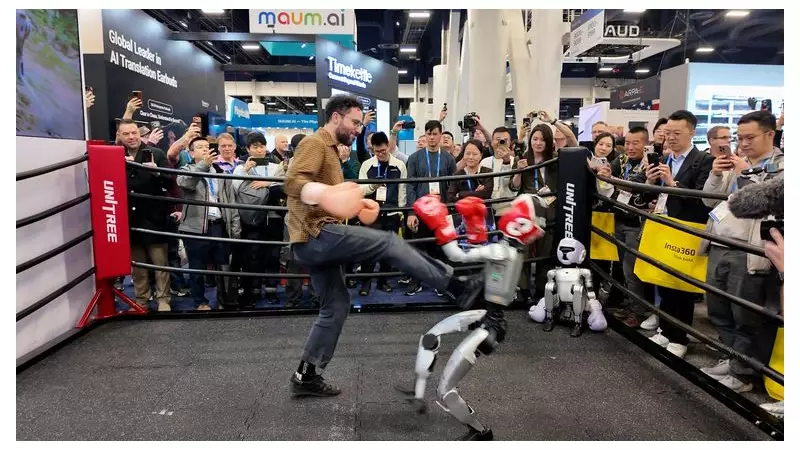
At the world's largest technology conference, a unique bout took place that highlighted both the remarkable progress and the persistent limitations of humanoid robotics. Sky News' technology correspondent, Rowland Manthorpe, stepped into a ring at the Consumer Electronics Show (CES) in Las Vegas on Friday 9 January 2026 to physically confront a robot, offering a visceral insight into the state of the art.
A One-Sided Bout in Las Vegas
The invitation came from Chinese robotics firm Unitree, which wanted to demonstrate its G1 humanoid unit's ability to work alongside people. The match, however, was never going to be fair. The robot was programmed not to fight back, ensuring a human victory for the sake of the demonstration. Manthorpe described the initial sensation of punching the machine as akin to "hitting a brick wall," a jarring impact that travelled back up his arm.
Switching tactics proved more effective. A solid kick sent the G1 unit stumbling backwards into the ropes of the ring. Unlike a human, the robot showed no sign of fatigue or frustration. It bounced straight back up, ready for further punishment, showcasing a key robotic strength: indefatigability. Yet, its weakness was equally apparent. The machine lacked the agility to dodge or evade blows, moving with a rigidity that left it vulnerable.
Beyond the Hype: The Reality of Robot Butlers
The spectacle at CES came amid soaring hype around physical AI, fuelled by statements from industry leaders like Nvidia's CEO Jensen Huang. Huang had confidently predicted that robots with human-like capabilities would arrive "this year," citing the rapid pace of technological advancement. However, Manthorpe's experience and investigations across the show floor suggested a more nuanced and delayed timeline.
The fantasy of a robot butler seamlessly handling household chores remains distant, primarily because human bodies and behaviours are extraordinarily difficult to reproduce. A prime example was a laundry-folding robot, a significant technical achievement in dexterity. Yet, it required four days of remote operation just to adapt to the new table and lighting at CES. Furthermore, while it could fold for 16 hours a day, it couldn't transport the laundry, limiting its practical utility. The company behind it, Dyna, rents it to hotels for $3,000 to $5,000 per month.
The Fundamental Challenge: Balance and Touch
The question of balance symbolises a core hurdle for the entire robotics field. Humans don't just balance; we constantly recalibrate and rethink tasks mid-motion. For robots, achieving this dynamic stability is immensely complex. Making a robot light and nimble also means equipping it to handle unexpected instability, a problem still being solved.
Another frontier is replicating the human sense of touch and the adaptive strength of our hands. Technologists embed tactile sensors in robotic fingertips to measure grip and weight. A crucial goal is achieving "back-driveability" – the ability for a robot's joints to yield under force rather than lock up, much like human muscles absorbing an impact.
South Korean company WiRobotics demonstrated an actuator (a robotic muscle) with in-built force recognition designed for this purpose. Its founder, Dr Yong-Jae Kim, explained it could "absorb the impact and even utilise the impact." The result was a robot capable of a surprisingly human-like handshake. However, this single achievement underscores the distance to go, as human hands dynamically switch between softness and rigidity for different tasks.
A New Path Forward with Generative AI
Despite the challenges, a wave of optimism is sweeping the industry, driven by the integration of generative AI. Every roboticist Manthorpe spoke to agreed that this technology has revolutionised their work. Aya Durbin, humanoid application product lead at Boston Dynamics, stated: "Robotics has completely changed. We can make robots feel more like people."
This new toolkit provides a clearer path toward more adaptable and capable machines. The consensus from CES 2026 is that advanced humanoid robots are inevitable, but their arrival in our homes and workplaces will likely take "a bit longer than many people hope and fear." The journey involves solving fundamental problems of physics and adaptability that come naturally to humans but remain a monumental task for engineering.