US Restaurants Targeted for Opposing ICE Immigration Policies
Restaurants across the United States are facing significant backlash, including one-star reviews and declining business, for publicly opposing Immigration and Customs Enforcement (ICE) policies. In an already precarious industry, some immigrant restaurateurs fear speaking out, highlighting the growing tensions around immigration enforcement under the current administration.
Visible Protests and Immediate Consequences
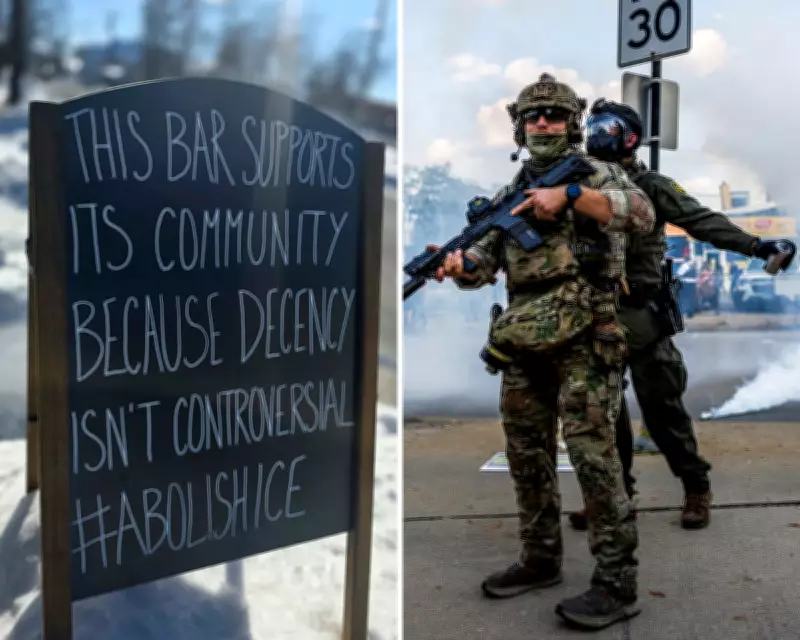
Amid calls for a national shutdown on 30 January, Anton Kinloch displayed a chalkboard sign outside Lone Wolf, his craft cocktail bar in Kingston, New York. The message read: "WE LOVE ICE IN DRINKS. WE DON'T LOVE ICE IN REAL LIFE. SOLIDARITY ALWAYS." Kinloch and his wife Lisa Dy chose to stay open, donating a portion of proceeds to a local immigrant advocacy group, but within hours, the sign was vandalized and thrown into the street, appearing to have been run over multiple times.
Kinloch reported receiving derogatory messages on social media and noted that other local business owners faced similar threats and a decline in followers after speaking out. This incident reflects a broader pattern of aggression against businesses taking a stand on immigration issues.
Online Harassment and Fake Reviews
Since the return of the previous administration, restaurants have become frontline targets for intimidation. Jamie Kenyon, executive chef of Bottino in New York City, faced an obscenity-laced phone call and negative Google reviews after posting a pro-immigrant message. One review falsely accused the restaurant of having "horrendous values and morals," potentially causing reputational damage. A 2015 Moz report indicates that businesses risk losing 22% of customers from a single negative review, making such attacks particularly damaging.
Similarly, Cheetie Kumar, co-owner of Ajja in Raleigh, North Carolina, has experienced online backlash, emphasizing the delicate balance between advocacy and safety for immigrant staff. Many restaurateurs, who are immigrants themselves, feel increasingly vulnerable in this hostile climate.
Physical Confrontations and Refusal of Service
In Chicago, Jason Vincent, co-owner of Pizza Matta, refused service to an ICE supporter after months of harassing messages, stating, "I refuse to cook for fascists and their enablers." While not official policy, Vincent reserves the right to deny service to individuals wearing pro-ICE attire, citing his Jewish heritage and the principle of "never again." This stance has led to contentious exchanges, reflecting the deep divisions within communities.
Impact on Business and Workforce
The restaurant industry, where immigrants comprise 22% of the workforce (over 30% in states like California and New York), faces severe threats from aggressive immigration enforcement. Sean Sherman, chef-owner of Owamni in Minneapolis, warns that deporting immigrant workers would be catastrophic, as "people of color and immigrants have been holding up the entire food system." In Minneapolis, restaurant sales have dropped by 50-60% due to federal targeting, with Sherman predicting widespread closures if the pace continues.
In Chicago, Vincent noted that tear gas deployment by ICE agents near his restaurant Giant led to the slowest night in its ten-year history. These economic impacts compound existing challenges like inflation and rising costs, putting immense pressure on small businesses.
Advocacy and Legal Challenges
Restaurateurs are not only fighting online trolls but also engaging in advocacy. Sherman delivered a petition with over 3,000 signatures to Senator Tina Smith, urging Congress to rein in ICE, after an Owamni employee was apprehended despite proper documentation. This highlights the real-world consequences of enforcement actions on individuals and businesses.
Kenyon, a naturalized citizen from England, stresses that sensible enforcement should focus on criminals, not innocent workers, noting that immigrants' "biggest 'crime' is working and giving back to the community." As tensions rise, the restaurant industry's voice becomes crucial in shaping the national conversation on immigration and equality.