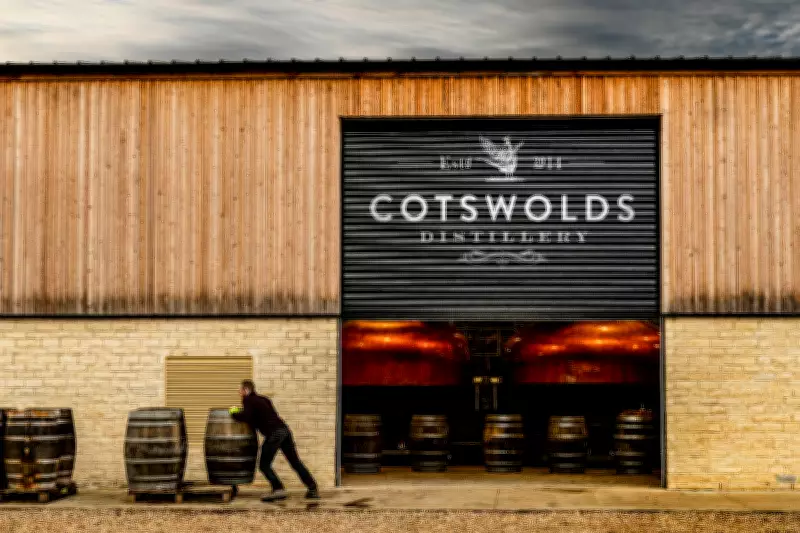
The Cotswolds Distillery: Defining the Brand of English Whisky
The English whisky sector is experiencing a remarkable renaissance, with over 60 distilleries currently operating across the country in various stages of development. Among these, 38 are actively producing and selling spirit, while the remainder are maturing new-make spirit that has yet to reach the market. When the Cotswolds Distillery launched in 2014, the category was significantly smaller, with virtually all English distilleries in operation today having begun production within the last decade, aside from a few exceptions.
English Whisky's Historical Context and Modern Revival
English whisky boasts a long and storied history, with records indicating active producers as early as the 1500s, coinciding with the birth of the Scotch whisky sector. Production surged in the early 1800s, but by the end of the century, only a handful of producers remained. The last English distillery closed in 1905, leaving the category dormant for nearly a century until The English Whisky Company in Norfolk initiated production in 2006, widely regarded as the grandfather of the modern English whisky sector.
Over the past decade, the Cotswolds Distillery has ascended to the top shelf, thanks to its unwavering commitment to quality and brand identity. Founded in 2014 by Dan Szor, a former New York financier, the distillery emphasizes the Cotswolds region as much as its whisky and gin. Located in Stourton, within the heart of the Cotswolds, it was designed to produce high-quality, local spirits using barley grown within 50 miles. The first project was the Cotswolds Dry Gin, released shortly after founding, followed by the first Cotswolds Signature Single Malt Whisky in 2017.
Strategic Market Entry and Brand Development
The Cotswolds Distillery entered the gin market at an opportune moment. According to research firm IWSR, UK gin consumption skyrocketed from 35 million 70cl bottles in 2011 to 96 million in 2020, driven largely by increased sales of artisan-brand gins. Between 2013 and 2019, premium gin sales in the UK expanded sharply, with double-digit annual growth rates at the peak of the trend. For instance, in 2018, sales of artisan-brand gins at large grocers surged by 167 percent, compared to a 30 percent rise in mass-produced gins.
In 2020, as lockdowns were implemented globally to curb the coronavirus pandemic, UK spirits sales increased dramatically, rising by more than a fifth. Although much of this boom has since subsided, the Cotswolds Distillery's strong brand has enabled it to stand out in an increasingly competitive field.
Leveraging Regional Appeal and International Expansion
Visits to the Cotswolds region have broken records year after year since the pandemic, now totaling around 35 million annually, with some areas reporting double the number of visitors compared to 2019. While US and Canadian visitors constitute approximately 40 percent of the tour market, there has been a steady rise in visitors from India, who now make up four percent of the customer base.
The Cotswolds brand and the international diversity of visitors have undoubtedly helped the distillery carve out a niche in the competitive English whisky market. The next phase of expansion targets the international arena. Dan Szor states, "We want to move from being a leading craft distillery to becoming the defining brand of English single malt whisky." He adds, "English whisky is still a young category, and the next phase is about building global recognition for it in the same way Irish whiskey or Japanese whisky did over the past two decades."
This involves breaking down barriers and introducing English single malt whisky to consumers who typically opt for Scotch. Szor notes, "Scotch has had hundreds of years to build a reputation, whereas modern English whisky is only just beginning to reach global drinkers." He emphasizes that age should not hinder the whisky's appeal, stating, "Age is only one factor — and sometimes not the most important one. A younger whisky made with exceptional ingredients and great casks can easily outperform an older one that hasn't been treated with the same care."
Innovative Collaborations and Award-Winning Quality
To enhance awareness, the distillery has capitalized on its surroundings and 'Englishness' through collaborations such as the Highgrove Evergreen whisky. This expression is made from heritage Plumage Archer barley grown on the Highgrove estate in Gloucestershire, the private residence of King Charles III and Queen Camilla. Created in collaboration with the King, the packaging features a painting of Highgrove House by the King himself. Szor explains that traditional floor malting creates a "very direct link between field and glass," showcasing how "ingredients, farming, and place can be just as important in whisky as they are in wine."
Beyond this, the distillery has partnered with Blenheim Palace and Fortnum and Mason to develop highly marketable 'English' products. Product quality remains paramount, with the Cotswolds Distillery earning multiple awards, including Gold for their Sherry Cask Single Malt at the 2025 World Whiskies Awards and Gold at the 2023 San Francisco World Spirits Competition for their Bourbon Cask.
As challenges emerge in the UK whisky sector, the Cotswolds Distillery, with its robust global brand, is well-positioned to navigate the storm and continue defining the future of English whisky.