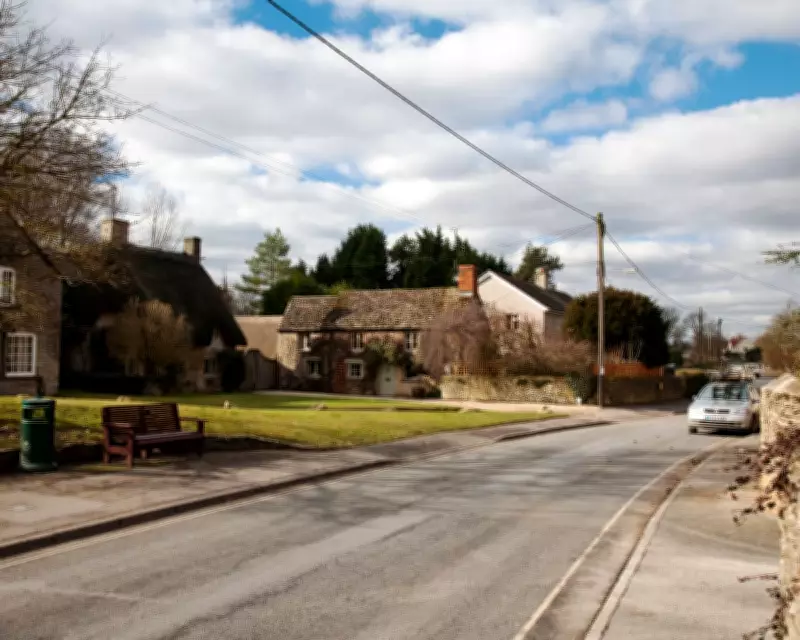
What does a "food desert" look like? In the case of the modestly affluent Cotswolds village of Kempsford, very pretty. When visiting, the sun shines from cloudless blue skies onto lovely honey-coloured stone houses, some draped in purple wisteria. Aside from the loud hum of US air force planes revving up at the nearby Fairford airbase, it is a picture of rural calm. There is a primary school and a pub. A house on the main street is called "The Old Bakery." But there is no shop selling food for miles.
There is no evidence people go hungry in Kempsford, but it illustrates the paradox of rural food deserts: food is often easier to access, cheaper, healthier, and more abundant in the most deprived urban neighbourhoods than in relatively affluent areas such as the Cotswolds. For lower-income families, especially if they do not have a car, one of the biggest risk factors for food insecurity—inability to access nutritious food, skipping meals, and going hungry—is country living, a recent University of Sheffield study found.
The Nearest Food Shops Are Miles Away
The nearest food shops to Kempsford, according to Anton Wynn, head of South Cotswolds food bank, are convenience stores in Fairford, more than 3 miles away. Driving takes a few minutes, but there is no direct public transport. You could walk to the tiny Fairford Co-op, but it is a three-hour round trip along busy roads. For value and choice, the best bet is the big Aldi in Cirencester, a market town 10 miles away. The bus from Kempsford runs there once a day, three times a week, but drops you a mile from the supermarket. You have less than three hours before the return bus leaves.
Taking a shopping list of basic food products, it turns out that if Kempsford is your starting point, almost everything on the list is radically cheaper at the store that is furthest away and hardest and most expensive to get to if you do not have a car. At Aldi, for example, a packet of spaghetti costs 28p; at the Co-op it is 90p. A bag of six apples at Aldi is 99p, and £2.50 at the Co-op. Rice is 52p (£2.45). A tin of tuna is 59p (£1.35). The bill comes to £16.17 at Aldi, £26.81 at the Co-op. At a time when food prices have soared, this represents a rural premium of 65%.
Hidden Food Inequality Behind the Beauty
Wynn says the deep-rooted problems of food inequality are hidden behind the area's affluence and chocolate-box beauty. The food bank now delivers 60-70% of its food parcels, after it realised most clients had no easy or affordable means of getting to its Cirencester centre to pick them up. Bethany Groom, 24, has two young children and lives in Kemble, 6 miles from Cirencester. "It's an absolutely beautiful village," she says. The local store is great for food "top-ups," she says, but expensive. Supermarket home deliveries are costly, and a once-a-week food drop impractical when you are eking out a tight budget. She does not drive, and the logistics of food shopping, preschool care, and NHS appointments are exhausting. Booking a return taxi to Aldi would eat up most of her weekly food budget. "I book the [dial-a-ride] bus two weeks in advance. My main focus is: can I get a bus? Then: how long have I got in town?"
The Rise of Rural Food Deserts
The rise of the rural food desert—often, ironically, in areas where much of the UK's food is produced—reflects profound social changes: the rise of the supermarket, mass closure of rural shops and post offices, car culture, the collapse of public transport, and changes in family structure. Wynn recalls a Cotswolds village childhood in which his grandparents lived close by, grew fruit and vegetables, and kept rabbits for eating. There was a local baker, a butcher, and a grocer. Extended families and the local church were at the centre of a cohesive and supportive community. Much of this way of life has disappeared.
Lack of Market Solutions
Food retail economics mean the free market is unlikely to provide a solution to food inequality in the Cotswolds. The food bank is supportive of the idea of mobile low-cost food clubs visiting outlying villages, but the intractable problems of cost and geography—when, where, and how often these pop-ups would appear—remain. Cotswold district councillor Tristan Wilkinson says the rural-idyll-on-steroids image that has drawn celebrity and wealth to the area can make it hard to convince policymakers it has pressing social needs. He calls for an "infrastructure first" approach to new development, prioritising shops and transport as well as new housing. It is not just about access to food but a range of essential services, like job centres, childcare, and health, he says. As fuel prices rocket, even the car-owning middle class is feeling the strain. At times, he says, it seems "we are being penalised for living in a rural community."