
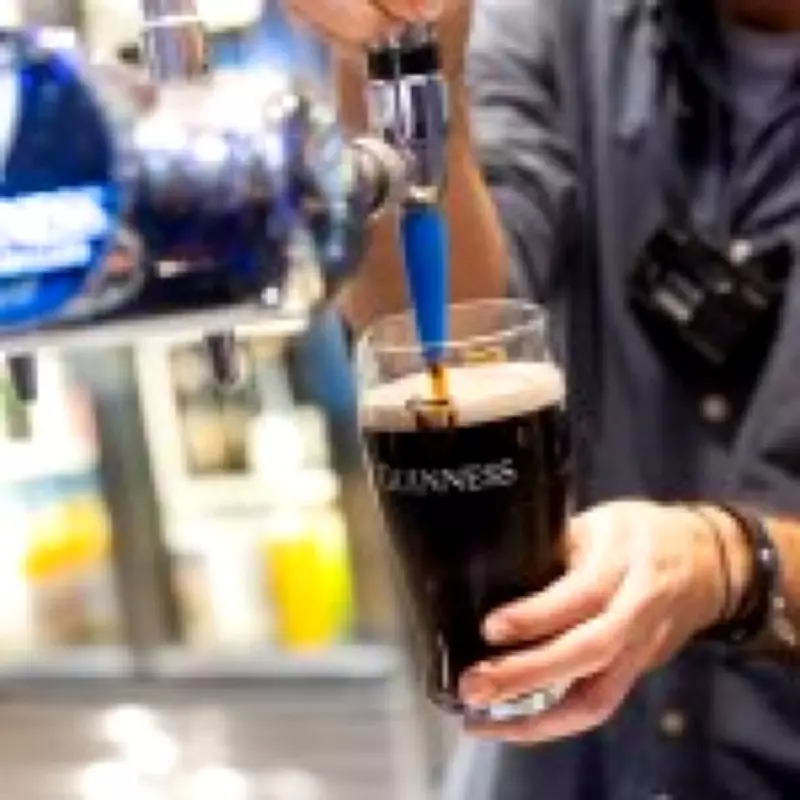
AI Bot 'Rachel' Uncovers Stark Price Divide for Guinness Across UK Pubs
In an unprecedented technological survey, an artificial intelligence bot named 'Rachel' has conducted tens of thousands of polite phone calls to pubs across the United Kingdom over the Easter Bank Holiday weekend. The purpose? To meticulously gather data on the current price of a pint of Guinness, creating what has been dubbed the 'Guinndex' – a comprehensive map revealing both the cheapest and most expensive pints of the iconic Irish dry stout nationwide.
The Guinndex Findings: From £2.50 to £10 Per Pint
The AI agent, which features an accent inspired by Rachel Duffy from the television series The Traitors, successfully obtained pricing information from 6,500 of the nearly 36,000 pubs it contacted. The resulting data paints a vivid picture of regional disparities. At the extreme ends, the map identifies a Wetherspoons pub in Sittingbourne offering a pint for just £2.50, while in Maldon, consumers face a staggering £10 for the same beverage.
Nationally, the average price for a pint of Guinness stands at £5.82. However, this figure masks significant geographical variations. London emerges as the most expensive region, with an average pint costing a whopping £6.72. In contrast, Scotland presents a far more moderate average of £5.20. The survey also highlights a distinct 'Guinness equator' – a line running through Oxford, Cambridge, and Norwich. Pubs located south of this line charge an average of £6.18, which is 73 pence higher than those in the north, underscoring a persistent North-South economic divide.
The Creation of Rachel and the Guinndex Project
The innovative Guinndex was developed by Matt Cortland, a 37-year-old software engineer from New Jersey now residing in the UK, in collaboration with Irish AI researcher John Fleming. Cortland was inspired to create the index after a shocking experience in a Dublin pub, where he was quoted €7.80 (approximately £6.80) for a pint of Guinness. "I was like, 'what the f**k is going on?'," he recalls. "You can literally go two streets over and pay €6.20, so it didn't make any sense."
A key motivation for the project was the absence of official data; the Irish government ceased tracking stout prices in 2011, when the average was a mere €3.93. The AI agent, Rachel, represents a powerful autonomous model designed to fill this information gap. Remarkably, only 4% of the bartenders and pub landlords who answered the phone detected they were speaking with a bot.
Pub Reactions and Additional Discoveries
The transcripts of Rachel's conversations, reviewed by Metro, reveal a spectrum of human reactions. While some staff were courteous, addressing the bot as 'Rach', 'darling', or 'babes', others were less impressed. A staff member at the Kevill Arms in Great Yarmouth bluntly told Rachel to "piss off." Some respondents even provided joking figures, such as claiming a pint cost £593.
At The Earl of Normanton in Wiltshire, where a Guinness costs £5.60, a staffer remarked, "You think I ought to know that off the top of my head. That's the problem with, uh, technology." Beyond pricing, Cortland and Fleming's research extended to analyzing the names of Britain's over 46,000 pubs. They found 'Wellington' to be the most common historical name, appearing on 126 pub signs, followed by 'Nelson' (100) and 'Robin' (62). The study also noted that 7.2% of English pubs are named after royalty, with lower percentages in Wales (5.4%), Scotland (3.3%), and Northern Ireland (1.3%).
"The pub signs tell you more about the Union than any opinion poll," the researchers observed, adding humorously that the prevalence of 'cock' in pub names (117 instances) was "pretty funny."
Understanding the Soaring Cost of a Pint
The price of beer has been on a steep upward trajectory for decades. In 1987, a pint cost just 93p; by 2024, the average had risen to £4.77 – a 413% increase. Despite its premium price, Guinness was Britain's top-selling beer by volume in 2024, according to hospitality data consultancy NIQ. The stout has undergone a remarkable image transformation, evolving from a traditional older person's drink to the beverage of choice for Generation Z, with its popularity even causing a brief shortage in 2024.
Pubs across the UK have faced immense pressures in recent years, grappling with high inflation, the aftermath of the coronavirus pandemic, and escalating costs for staffing and licensing. This has led to a concerning trend, with one pub in England and Wales closing its doors every day last year. Furthermore, global geopolitical tensions, such as the conflict involving the US, Israel, and Iran, have driven up oil prices, indirectly impacting costs at both petrol and lager pumps.
Matt Cortland points out that individual pubs, not the brewery giant Diageo, set the price for Guinness. He suggests that some establishments may be exploiting tourists to cover their rising operational costs. "I've owned pubs before, I know what it's like to deal with rising costs and improvements and other overheads," he explains. "But there's a difference between reasonably charging something and taking advantage."
A Tool for Transparency, Not Shaming
Despite some mixed reactions, Cortland reports that most publicans have welcomed the Guinndex initiative. Some have even lowered their prices or requested to be prominently featured on the map as a point of pride. He emphasizes that the dataset is not intended as a 'name and shame' exercise but rather as a transparent listing of publicly advertised prices.
"I'm trying to highlight hidden gems that do really good things as much as possible," Cortland states. "But if you're charging €10, that's what you're charging people publicly, that should be fair enough information." The UK-wide Guinndex follows an Ireland-exclusive version published earlier this month, providing consumers with an unprecedented tool for navigating the variable landscape of pint prices.




