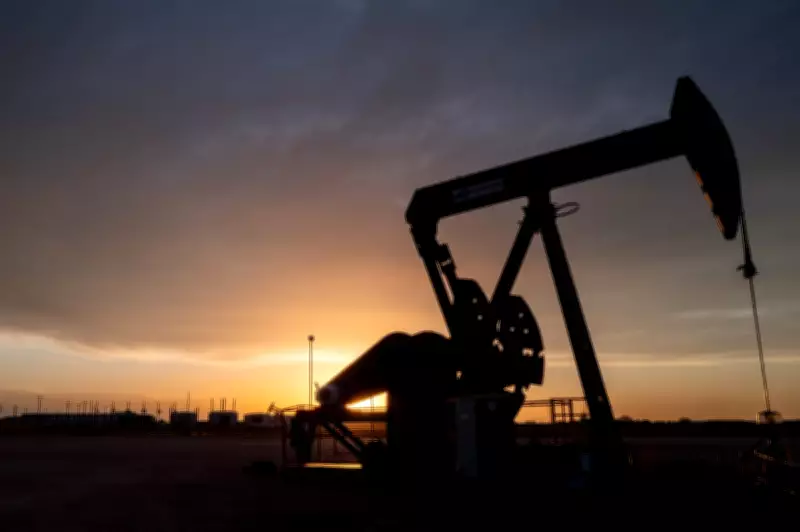
The Illusion of American Energy Independence
One month has passed since the US and Israel's military actions against Iran effectively closed the Strait of Hormuz, a critical chokepoint through which approximately twenty percent of global oil supplies typically flow. The resulting supply disruption has sent oil prices soaring worldwide, sparking fears of sustained instability in energy markets. Despite President Donald Trump's assertions that this crisis doesn't concern the United States, energy analysts and economists are revealing a more complex reality that directly impacts American consumers.
Trump's Claims Versus Market Realities
President Trump has repeatedly declared that the United States is "totally independent" of Middle Eastern oil supplies, stating emphatically that "we don't need their oil." In a recent prime-time address, he pointed to America's status as the world's leading producer of oil and gas, bolstered by the fracking revolution that has transformed domestic energy production. "Under my leadership, we are the number one producer of oil and gas on the planet," Trump asserted, adding that this position insulates the country from global supply disruptions.
However, energy market experts paint a different picture. While the United States does indeed produce more oil than it consumes and has become a net exporter, the global oil market operates as an interconnected system where regional price shocks inevitably spread worldwide. Clark Williams-Derry, an analyst at the Institute for Energy Economics and Financial Analysis, explains this phenomenon using a vivid analogy: "Think of it like a giant swimming pool. There are waves or ripples, but the whole swimming pool rises or falls. The fundamental level is set by the global market."

The Interconnected Nature of Global Oil Markets
Unlike natural gas markets, where prices can vary dramatically between regions due to transportation challenges, oil markets are fundamentally globalized. The Brent crude benchmark, which serves as the international standard, has surged by nearly fifty percent since the conflict began, surpassing $100 per barrel. This increase occurred despite Trump's confident pronouncements about American energy security.
"Under current policy, being a net exporter doesn't do anything to cushion the US from global price trends," Williams-Derry emphasizes. The United States continues to import millions of barrels of oil daily, with Gulf nations supplying almost ten percent of those imports last year. Furthermore, many American refineries are specifically designed to process heavier crude varieties than the lighter oil predominantly produced domestically, creating ongoing import dependencies.
Beyond Oil: Wider Economic Consequences
The economic repercussions of the Gulf crisis extend far beyond petroleum markets. Global fertilizer costs have escalated sharply, prompting American farmers to reconsider their planting strategies as the Strait of Hormuz remains effectively closed. A significant portion of US fertilizer imports originates from the Middle East, creating additional supply chain vulnerabilities.
Additionally, Qatar's decision to halt helium production last month has raised concerns across multiple industries. The country typically supplies approximately one-third of the world's helium, which plays a crucial role in semiconductor manufacturing. This disruption could potentially impact everything from electronics to medical equipment production in the United States.
American Consumers Feel the Pinch
For ordinary Americans, the most visible impact has been at the gasoline pump. Average nationwide fuel prices recently breached $4 per gallon for the first time since 2022, creating widespread frustration among drivers. Neale Mahoney, Trione director of the Stanford Institute for Economic Policy Research, notes that while higher oil prices benefit certain sectors of the US economy—particularly energy-producing states like Texas, New Mexico, and North Dakota—they offer no protection to consumers.
"Because of the oil price increasing, it is going to be beneficial to certain sectors of the US economy—the energy production sectors—and certain states within the US," Mahoney explains. "While it doesn't protect the US consumer, and US consumers will be feeling the squeeze, there are winners as well as losers in the US."

Political Implications and Future Outlook
With seven months remaining until November's midterm elections, and Republican control of Congress hanging in the balance, rising fuel prices could significantly influence political outcomes. History has shown that high gasoline costs can derail political campaigns, making this economic issue particularly sensitive for incumbent politicians.
President Trump has expressed confidence that prices will decline rapidly once the conflict concludes, predicting that "when this conflict is over, the strait will open up naturally" and fuel costs "will rapidly come back down." However, Mahoney, who served on the White House National Economic Council during the Biden administration, cautions against expecting a swift reversal.
"There is the famous rockets-and-feathers phenomenon with retail gas and petrol prices, where they shoot up fast and float down like a feather," Mahoney observes. "Even if crude prices were to drop pretty quickly, we are likely to see elevated pump prices through the spring and middle of the summer."
As the Gulf crisis continues to unfold, the notion of American energy independence appears increasingly tenuous. While domestic production has undoubtedly strengthened the nation's energy position, the interconnected nature of global markets means that supply disruptions halfway around the world still translate directly into higher costs for American households, revealing what experts describe as a persistent vulnerability behind the rhetoric of energy sovereignty.