Oil prices have surged dramatically, reaching their highest levels in seven months as escalating tensions between the United States and Iran have sent shockwaves through global commodity markets. Traders are actively hedging against the potential for military conflict ahead of crucial nuclear negotiations scheduled for this week.
Market Reaction to Geopolitical Tensions
On Monday, US crude futures climbed to $67.28 per barrel, while Brent crude touched $72.50 per barrel, marking its highest point since July 31st. Although prices experienced a slight pullback late in the trading session, they resumed their upward trajectory on Tuesday morning, approaching Monday's peak levels once again.
James Hosie, a research analyst at Shore Capital, explained that oil markets are "rationally trying to price in a risk premium for oil prices, given the disruption a conflict could have on global supplies." This sentiment was echoed by Priyanka Sachdeva, a senior market analyst at Phillip Nova, who noted that "the risk of possible military escalation in the Middle East is gaining traction, and thus, traders appear to hedge against worst-case scenarios."

Anticipation Versus Actual Supply Disruption
Sachdeva emphasized that the current price surge is "largely driven by anticipation rather than actual supply loss," highlighting how market psychology is playing a crucial role in the commodity's valuation. The heightened anxiety stems from the upcoming third round of nuclear talks between Washington and Tehran, scheduled for Thursday in Geneva, as confirmed by Oman's foreign minister on Sunday.
These negotiations represent a significant diplomatic effort, with Donald Trump's administration believing Iran may be willing to dilute its stockpile of highly enriched uranium and abandon its nuclear program. Iran has consistently denied allegations that it is attempting to develop atomic weapons, creating a complex backdrop for the discussions.
Military Posturing and Diplomatic Maneuvers
In a Truth Social post on Monday, Trump issued a stark warning, stating it would be a "very bad day" for Iran if it fails to reach an agreement. This rhetoric has been accompanied by visible military posturing from both nations in the lead-up to the talks.
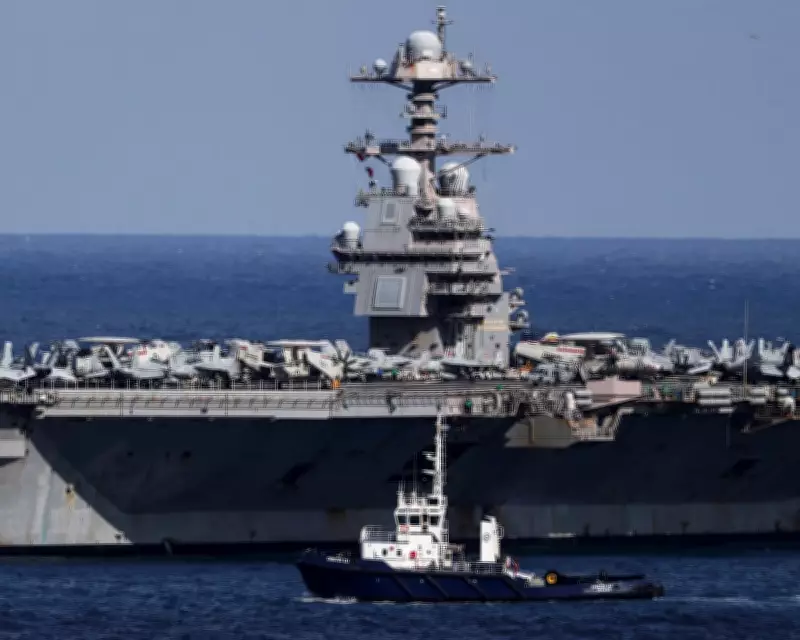
The United States has significantly bolstered its military assets in the Middle East over the weekend. On Monday, the aircraft carrier USS Gerald R Ford arrived at Souda Bay on the island of Crete, Greece, while the USS Abraham Lincoln remains positioned in the Arabian Sea near Oman, equipped with fighter jets and manned by more than 5,630 sailors.
Security Concerns and Regional Implications
Adding to the tense atmosphere, the US partially evacuated its embassy in Beirut on Monday following a comprehensive security review that assessed the risks of military escalation in the region. This precautionary measure underscores the seriousness with which American officials are viewing the current geopolitical landscape.
The combination of diplomatic negotiations, military demonstrations, and security precautions has created a volatile environment that commodity traders are monitoring closely. As the world watches the developments between these two nations, oil markets continue to reflect the uncertainty, with prices serving as a barometer for geopolitical risk in one of the world's most crucial energy-producing regions.