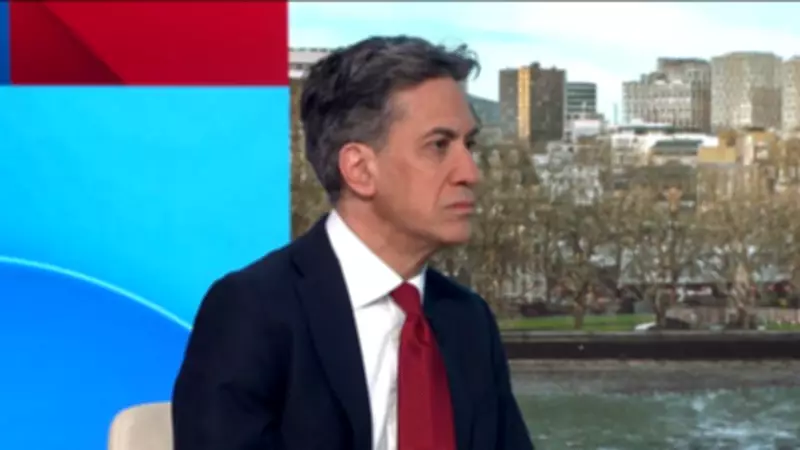
Energy Secretary Pledges Action on Costs While Withholding Specific Support Details
Energy Secretary Ed Miliband has declared that the government will "fight people's corner" regarding escalating energy costs, though he notably declined to specify exactly what assistance measures might be implemented. The Labour minister made these remarks during an interview on Sky News' Sunday Morning with Trevor Phillips, as tensions in the Middle East threaten to trigger another energy price crisis affecting British households.
Government Warns Against Price Gouging Amid Market Concerns
"We're going to fight people's corner... when it comes to the effects on them," Miliband stated emphatically. "That's why this week, we've been saying to the petrol retailers, the heating oil companies, we're not going to tolerate price gouging. We're not going to tolerate unfair practices. Some people don't like that. But that's tough."
However, when pressed about potential government interventions, Miliband remained deliberately vague: "I'm not going to speculate on how help will be provided if we do, if we make further interventions."

Heating Oil Support Package Expected for Vulnerable Households
Sky News has learned that the government plans to announce a targeted support package as early as Monday, specifically designed to assist the poorest households that rely on heating oil. This development comes as Chancellor Rachel Reeves appears to be holding off on implementing broader support measures for the time being.
The distinction between heating oil and other energy sources is particularly significant because approximately 1.1 million homes in England that use fossil fuels for heating remain disconnected from the national gas grid. In Northern Ireland, the situation is even more pronounced, with two-thirds of all households depending on heating oil for their warmth.
Geopolitical Tensions Drive Oil Price Surge
The current energy price pressures stem directly from escalating conflict in the Middle East, where Iran has effectively closed the strategically vital Strait of Hormuz by threatening attacks on oil tankers. This critical shipping lane typically handles around twenty percent of global oil exports, and its closure has driven oil prices from approximately $70 per barrel in February to over $100 per barrel currently.
While the energy price cap regulates gas and electricity costs and is actually scheduled to decrease by an average of £117 starting in April, this regulatory mechanism does not extend to heating oil prices, leaving many rural households particularly vulnerable to market fluctuations.
Market Dynamics and Government Response Under Scrutiny
Miliband criticized what he described as dysfunctional market behavior: "This is a market that hasn't been working well. It's what they call rockets and feathers, that when the wholesale price goes up, prices jump up. And then when wholesale prices come down, they come down very, very slowly."
The energy secretary's comments follow a tense meeting on Friday between government officials and fuel retailers, during which Miliband and Reeves warned against profiteering from motorists. Some retailers reacted angrily to what they perceived as "inflammatory language" from ministers, briefly threatening to withdraw from the discussions altogether.
Long-Term Energy Strategy Emphasized
Miliband emphasized that the current crisis underscores the need for fundamental changes to Britain's energy infrastructure: "We've got to learn the lesson of this crisis... If we are exposed to these fossil fuel markets at a time of the greatest geopolitical instability we've seen in generations, then it's the British people who end up paying the price."
The energy secretary pointed to government initiatives aimed at increasing renewable and nuclear energy generation as part of the long-term solution. When questioned about potential expansion of North Sea oil and gas exploration, Miliband clarified that while existing licenses would continue to be utilized, new licenses would not contribute to reducing consumer energy bills.