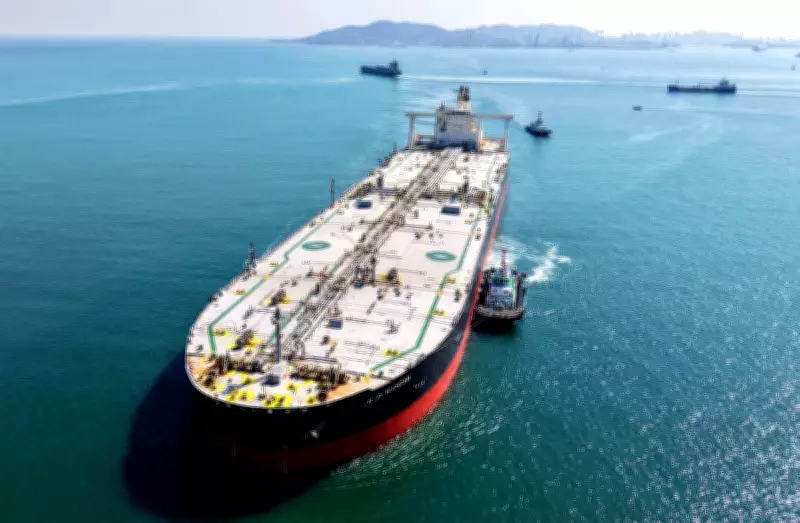
Middle East Conflict Ignites Global Economic Turmoil as Oil Prices Skyrocket
Early Monday, Asian financial markets experienced significant declines as escalating tensions in the Middle East propelled crude oil prices to alarming heights, sending shockwaves through international stock exchanges. The conflict has triggered an energy supply crisis, with economists warning of potential stagflation—a scenario where economic growth stagnates while inflation surges—posing severe risks to the worldwide economy.
Stock Market Plunge and Oil Price Surge
The price of key oil benchmarks achieved their highest weekly gains in six years by market open on Monday, soaring beyond $115 per barrel. This milestone marks the first time oil has exceeded $100 since Russia's invasion of Ukraine in 2022. The West Texas Intermediate benchmark for U.S. crude has nearly doubled from its January level of approximately $60 per barrel.
Oil prices climbed dramatically in the initial week of the conflict after Iran effectively closed the Strait of Hormuz, a critical maritime passage for about one-fifth of global oil and seaborne gas tankers. Recent production cuts across the Middle East have intensified fears of a supply shortage, with economic adviser Warren Hogan noting that the prolonged conflict reduces the likelihood of price stabilization.
Asian markets reacted sharply, with Japan's Nikkei falling over 6% and South Korea's Kospi dropping more than 7%. European and U.S. markets are anticipated to follow this downward trend as investor confidence wanes.
Inflationary Pressures and Global Impact
The surge in oil prices is expected to drive inflation worldwide. Royal Bank of Canada economists project that U.S. inflation could rise to 3.7% if oil prices remain at $100 per barrel. In the United States, fuel prices have increased by 25 cents over the week, with an additional 25-cent hike over the weekend, averaging $3.44 per gallon by Sunday night.
Higher fuel costs not only drain consumer wallets but also elevate business expenses, pushing up prices for goods ranging from food to furniture. Europe, which imports most of its oil and gas, saw natural gas prices rise nearly 67% in the conflict's first week. Meanwhile, China's producer prices could increase by 0.4 percentage points if high oil prices persist.
In Australia, inflation may approach 5%, nearly one percentage point higher than pre-conflict forecasts, with petrol prices potentially rising by a dollar per liter.
Stagflation Risks and Economic Slowdown
Oil price spikes are inherently stagflationary, slowing economic activity while boosting inflation. The International Monetary Fund estimates that a 10% increase in energy prices could reduce global economic growth from about 3.2% to 3%. The UK and euro area might each grow by just 1% or less if the conflict continues.
Asian economies, which have benefited from strong industrial production driven by the tech boom, face disruption from an energy shock, heightening stagflation risks. In the U.S., oil prices at $125 per barrel could cut GDP by 0.8% while inflation surpasses 4%.
Economist David Bassanese draws parallels to the 1970s, when Middle East conflicts led to surging prices and prolonged economic slumps in advanced economies.
Interest Rate Implications and Future Projections
Interest rates are less likely to decline if the war persists, with central banks potentially hiking rates sooner than expected. The European Central Bank and Bank of Canada, previously forecast to hold rates steady in 2026, are now anticipated to increase rates at least once in the coming year.
In the U.S., the Federal Reserve may delay rate cuts until September, while the Bank of England could maintain steady rates throughout the year. Australia now faces expectations of two rate hikes in 2024, up from one before the conflict.
Potential Escalation and Mitigation Efforts
Even if the conflict de-escalates, oil prices are unlikely to return to January lows, as traders may impose a risk premium. Countries in Asia, heavily reliant on Middle Eastern oil, are implementing emergency measures. Bangladesh has closed universities to conserve electricity, and South Korea has introduced fuel price caps for the first time in nearly three decades.
Economists warn that a month-long disruption could push oil prices to $120 per barrel, with Goldman Sachs estimating potential peaks at $145 per barrel—approaching all-time highs. A three-month disruption might drive prices to $185 per barrel, with severe repercussions for the global economy.