Federal Reserve Maintains Interest Rates Amid Global Turmoil and Political Pressure
The United States Federal Reserve has opted to hold interest rates steady for the second time this year, a decision widely anticipated by markets given the escalating conflict in the Middle East and consequent surge in energy prices. This move comes as Fed officials navigate a complex economic landscape marked by volatile inflation, a softening labor market, and intense political scrutiny from former President Donald Trump.
Confluence of Economic Challenges Weighs on Decision
During their latest policy meeting, Federal Reserve policymakers confronted a trifecta of pressing issues: skyrocketing oil and gas prices driven by the ongoing war between the US, Israel, and Iran; inflation metrics that continue to fluctuate above the central bank's 2% target; and an unexpectedly weak jobs report showing a loss of 92,000 positions last month. In an official statement, the board emphasized that "uncertainty about the economic outlook remains elevated" and noted the unpredictable implications of Middle Eastern developments for the US economy.
Eleven of the twelve voting committee members supported maintaining the benchmark interest rate within the range of 3.5% to 3.75%. The sole dissenter was Fed governor Stephen Miran, appointed by Donald Trump last autumn, who advocated for lower borrowing costs. This decision effectively rebuffs substantial pressure from Trump, who has repeatedly demanded rate reductions despite concerns that such moves could exacerbate inflationary pressures over the long term.
Energy Shock Creates Central Banking Dilemma
The conflict with Iran, now entering its third week, has triggered what economists describe as a classic energy shock, forcing central banks worldwide to balance the competing threats of rising inflation and economic slowdown. Joe Brusuelas, chief economist at RSM, characterized the situation as "a central banker's nightmare" that creates tension between a shaky labor market and mounting inflation. "While the Fed can take action to address a financial crisis by printing money and injecting liquidity into the financial system," Brusuelas noted, "it cannot print oil."
In response to the Fed's announcement, which highlighted uncertainty surrounding oil prices, US stock markets experienced significant declines Wednesday afternoon. The Dow Jones Industrial Average fell more than 1.6%, while the S&P 500 and Nasdaq Composite both dropped over 1.3%. The Bank of England's monetary policy committee is similarly expected to maintain interest rates when it meets Thursday, reflecting the global nature of the economic uncertainty.
Powell Acknowledges Economic Strain While Resisting Political Pressure
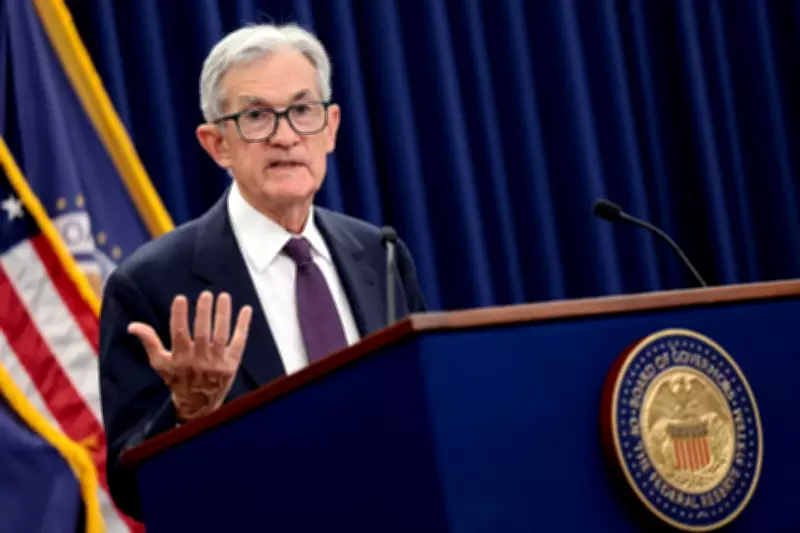
During a post-announcement press conference, Fed Chair Jerome Powell acknowledged that higher energy prices will likely drive up inflation in the short term but cautioned that "it is too soon to know its scope and duration of the potential effects on the economy." Powell emphasized that while the US economy remains fundamentally strong with resilient consumer spending and nearly three years of real wage growth, many Americans continue to feel financially squeezed. "It will take some years of positive, real earning gains for people to feel good again," Powell stated. "It makes us even more committed, if that's possible, to getting inflation back to 2% on a sustained basis."
The Fed chair has found himself increasingly at odds with Donald Trump, who has spent the past year demanding lower interest rates while implementing trade and immigration policies that Powell has identified as sources of economic instability. Trump recently asserted that rising oil prices represent "a very small price to pay" to achieve his objectives in Iran and benefit American oil producers who stand to profit from increased demand. This defiant stance mirrors his approach to tariffs, which economists credit with essentially flatlining the labor market since their announcement, resulting in just 181,000 jobs added throughout 2025—the lowest annual increase since the COVID-19 pandemic.
Legal and Political Battles Intensify Around Federal Reserve Independence
The Fed's decision unfolds against a backdrop of escalating legal and political conflicts concerning central bank independence. A federal judge recently halted a criminal investigation by the Department of Justice targeting Powell over renovations at the Fed's headquarters, with the judge citing "a mountain of evidence" suggesting the probe was intended to pressure the Fed into lowering rates. Powell characterized the investigation as a "pretext" for political interference.
Though the Trump administration has vowed to appeal this ruling, such action would likely delay confirmation of Kevin Warsh, the White House's nominee for the next Fed chair, who is widely expected to advance the president's agenda for lower interest rates. Powell noted that if his successor isn't confirmed by the end of his term on May 15, he will continue serving as chair until a replacement is installed, adding that he has "no intention of leaving the board until the investigation is well and truly over with transparency and finality."
In another potential constraint on Trump's influence over the central bank, the Supreme Court is poised to rule before June on his dismissal of Fed governor Lisa Cook. During January oral arguments, justices including Trump appointee Brett Kavanaugh expressed skepticism about the administration's position, questioning the potential negative economic consequences if the White House succeeds in exerting greater control over the Fed board.
Uncertain Future for Powell and Monetary Policy
This meeting represents the penultimate gathering for Powell as Fed chair, with his term scheduled to conclude in May after eight years leading the central bank. It remains unclear whether Powell will depart from precedent by remaining on the Fed board until his term as a governor ends in January 2028. When questioned about his future plans, Powell responded, "On the question of whether I will continue to serve as a governor after my term ends and after the investigation is over, I have not made a decision yet. I will make that decision based on what I think is best for the institution and for the people we serve."
Despite the geopolitical turmoil and political pressures, Fed officials maintained their projection for one quarter-point interest rate cut this year, unchanged from their January consensus. This cautious approach reflects the central bank's delicate balancing act between combating persistent inflation and supporting an economy facing multiple headwinds, all while defending its institutional independence from unprecedented political interference.