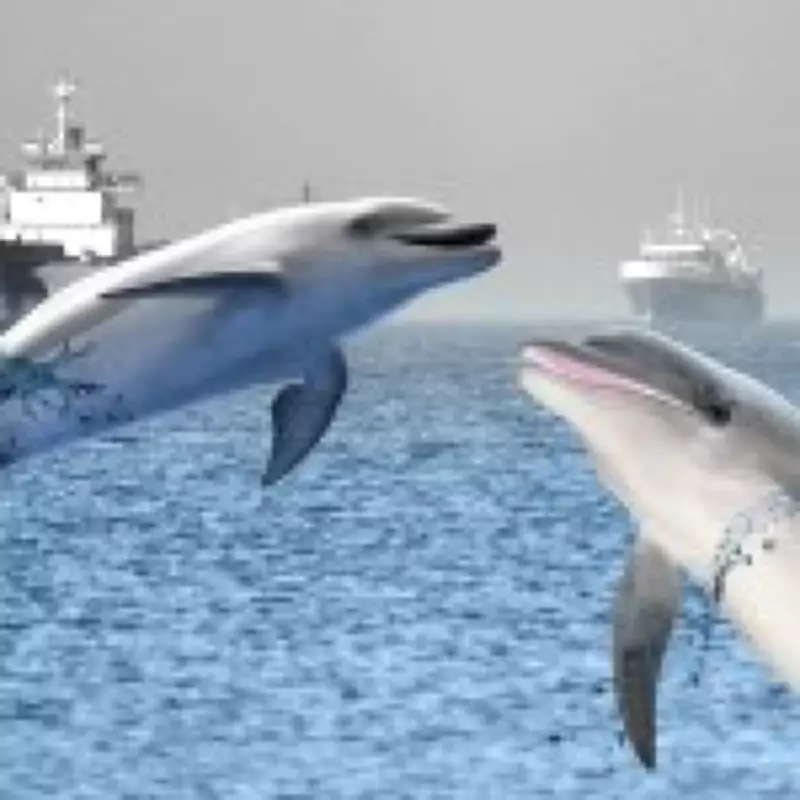
The United States has addressed claims about the use of kamikaze dolphins in the Strait of Hormuz, with the Secretary of War stating that Iran does not possess such marine animals, but declining to confirm or deny whether the US itself deploys them.
Pentagon Briefing on Kamikaze Dolphins
During a Pentagon briefing on Tuesday, Secretary of War Pete Hegseth was questioned by reporters about reports that dolphins were being weaponized in the Middle East. His response was notably ambiguous. 'I can't confirm or deny whether we have kamikaze dolphins, but I can confirm they don't,' Hegseth said, referring to Iran.
General Dan Caine, chairman of the Joint Chiefs of Staff, added a touch of humor to the discussion, stating, 'I haven't heard about kamikaze dolphins – it's like sharks with laser beams, right?' This remark drew parallels to fictional weaponized animals from popular culture.

Background on Military Dolphins
Reports of Iran using dolphins for military purposes date back to 2000, when Tehran allegedly purchased dolphins for training in military missions. More recently, Fox News aired a segment claiming that Iran was strapping suicide bombs to dolphins in the Strait of Hormuz. Fox News host Jesse Watters commented, 'These rogues are desperate.'
Dolphins have a long history of military use. In 1959, the US Navy began training dolphins and sea lions to detect mines, defend swimmers, and recover lost objects. In 2003, trained dolphins were deployed in southern Iraq to clear mines from waterways. These dolphins were trained to mark mines with floats, and the US Navy stated at the time that they posed 'no significant risks.'
Ceasefire and Strait of Hormuz Operations
Hegseth also confirmed that the ceasefire with Iran remains in effect, despite recent strikes by Tehran and the ongoing US blockade of the Strait of Hormuz. 'The ceasefire is not over,' Hegseth said, echoing earlier comments by General Caine.
US forces are continuing efforts to guide commercial ships through the Strait of Hormuz. So far, only two vessels, both American-flagged merchant ships, are known to have successfully passed through the safety corridor. General Caine described the operation as involving guided-missile destroyers, more than 100 aircraft, and 15,000 service members.
Hegseth emphasized that the US prefers a peaceful approach to guide the more than 22,500 mariners stranded on over 1,550 vessels out of the Persian Gulf, but the military is prepared if the situation escalates. 'This is a temporary mission for us,' Hegseth said. 'We expect the world to step up.'
Iran's Recent Aggression
General Caine told reporters that Iran's recent acts of aggression fall below the threshold of 'major combat operations,' meaning that Tehran, in the Trump administration's view, has not violated the tenuous ceasefire. This update came after the United Arab Emirates reported that Iran fired missiles and drones at it.
The Pentagon briefing provided clarity on the US position regarding both the dolphin claims and the broader geopolitical situation in the Strait of Hormuz, a critical waterway for global oil and gas transport.